


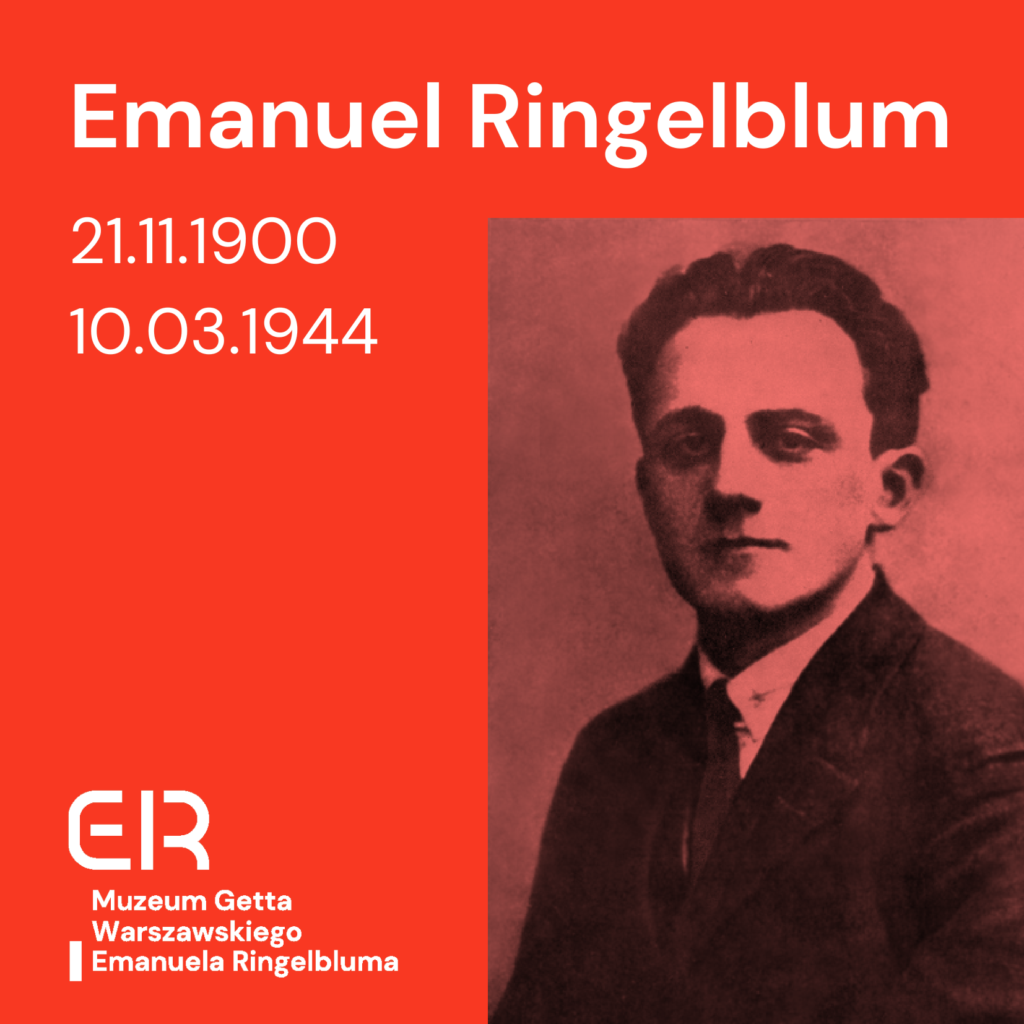
 Ringelblum was born in Buczacz, from where he moved with his family to Nowy Sącz during World War I. After passing his secondary school leaving exams, he began studying history at the University of Warsaw, where in 1927 he earned a doctorate in philosophy based on his dissertation "Jews in Warsaw: From the Earliest Times to the Last Exile in 1527." In 1928, he became a certified secondary school teacher. While working in a gymnasium, he pursued his passion for primary source historical research. He co-founded the Circle of Jewish Historians in Warsaw, and later the Warsaw branch of YIVO – the Jewish Research Institute in Vilnius. He was also involved in Jewish working-class circles.
Ringelblum was the author of over 120 articles in Polish and Yiddish, as well as two books. The first was his doctoral dissertation, and the second, "Jews in the Kościuszko Uprising," was published in 1937, first in Yiddish and a year later in Polish. On November 22, 1940, a week after the Warsaw Ghetto was sealed, Ringelblum inaugurated a meeting of a clandestine research group in his apartment at 18 Leszno Street, which henceforth operated under the codename Oneg Shabbat. Initially focused on collecting materials and documents relating to life in the ghetto in its broadest sense, the group eventually evolved into a thriving research center dedicated to documenting various issues related to life in the Warsaw Ghetto and the general situation of the Jewish population in occupied Poland.
At the end of February 1943, Ringelblum, along with his wife Judyta and son Uriel, left the ghetto and went to a hiding place "on the Aryan side." On the eve of the ghetto uprising, he left the shelter to enter the ghetto, where he was captured and sent to the camp in Trawniki. Four months later, thanks to his collaboration with the Polish underground, he was released.
In the "Krysia" bunker, as the hiding place was called, Ringelblum continued documenting the fate of Jews in occupied Poland. There, he wrote his final work, "Polish-Jewish Relations during World War II." The bunker at 81 Grójecka Street was discovered by the Germans following a tip-off. All the Jews housed there, along with their guardians, were deported to Pawiak prison, and after a few days, probably on March 10, 1944, they were shot in the ruins of the ghetto.
