August
Accessibility - Task 2

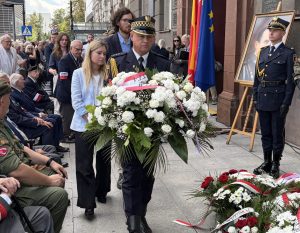
82st anniversary of the recapture of the PAST building by the insurgents
The capture of the Polish Joint-Stock Telephone Company skyscraper was one of the greatest successes of the Warsaw Uprising. On the 82nd anniversary of these events, a delegation from the Warsaw Ghetto Museum honored the memory of the heroic soldiers.

Helena Gotlib (1885–1942)
A film and theater actress of the pioneering Yiddish scene, she was born in 1885 in Grodno to an intelligentsia family. She spent her childhood and youth in Warsaw. She graduated from high school and, thanks to a friend who was an actress, met

Study visit to Lithuania
From July 8 to 10, the team from the promotion and education departments of our Museum visited – as part of a study visit – the Museum of the History of the Vilnius Jews and the Lost Shtetl Museum in Lithuania.
| FENiKS
The project is possible thanks to funding from the European Funds for Infrastructure, Climate, Environment 2021-2027 (FEniKS) programme.

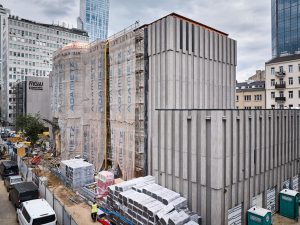
July 2026 at the MGW construction site
The former Bersohn and Bauman Hospital is gradually regaining its historic character. Careful finishing and conservation work has respectfully combined the complex's past with modern architectural solutions. Here's a summary of the most important
June 2026 at the MGW construction site
June 2026 was another busy month for the construction of the new home of the Warsaw Ghetto Museum. Construction work was underway simultaneously in many areas of the building, with installations progressing.

May 2026 at the MGW construction site
With each passing day, the investment is getting closer to completion. You could observe the wide range of construction, installation, and finishing works completed by May 2026 during the recent press conference.
16th November,
The borders ran along the following streets: Wielka, Bagno, Grzybowski Square, Rynkowa, Zimna, Elektoralna, Bankowy Square, Tłomackie, Przejazd, Nalewki, the border of the Krasiński Garden, Świętojerska, Freta, Sapieżyńska, Konwiktorska, Stawki, Dzika, Okopowa, Towarowa, Srebrna and Złota.
January 20 1942
A meeting was held on Großer Wannsee Street in Berlin, attended by Adolf Eichmann and Reinhard Heydrich, among others, to discuss the details of the planned genocide of the Jewish population. As the discussion continued, the Holocaust was already unfolding – through overpopulation, famine, and epidemics in the ghettos.
January 26 1942
In the Warsaw Ghetto, the Germans opened a wooden pedestrian bridge, the so-called footbridge, over the "Aryan" Chłodna Street at the intersection with Żelazna Street. It connected the so-called Large and Small Ghettos. Today, its symbolic reconstruction stands in its place.
April 17 1942
The German authorities targeted individuals suspected of conspiratorial activity, trade unionists, and social activists in the ghetto. The repression was carried out by the gendarmerie and police, the SS, the Gestapo, and officers of the Jewish Order Service. Fifty-two people were murdered.
June 19 1942
Author of "Diary from the Warsaw Ghetto," first published in New York in 1945. She lived in the ghetto, including on Sienna Street. She was interned in Pawiak Prison along with other Jewish citizens of the United States and Great Britain. She arrived in New York with her family in 1944.
July 22 1942
The German-led liquidation operation in the Warsaw Ghetto, during which approximately 265 Jews, constituting 75 percent of the ghetto's population, were deported to the Treblinka extermination camp. Approximately 10 were murdered on the spot. The operation ended on September 21st.