

She was born in Warsaw in 1920. Her father was rumored to be a staunch communist who fled to the Soviet Union due to persecution by the Polish authorities, only to disappear. Mira was still a little girl at the time, living with her mother and sister in modest circumstances. Mira's older sister, Tamar , recruited her into the leftist Zionist youth organization Hashomer Hatzair (Hebrew for "Young Guardian"). In 1938, Shmuel Breslav , leader of Hashomer's " Maanit " battalion, asked Mira to replace him as leader when he himself left for training camp. Mira began regularly visiting Hashomer's Warsaw headquarters, where she met Mordechai Anielewicz , who would eventually become her life partner.
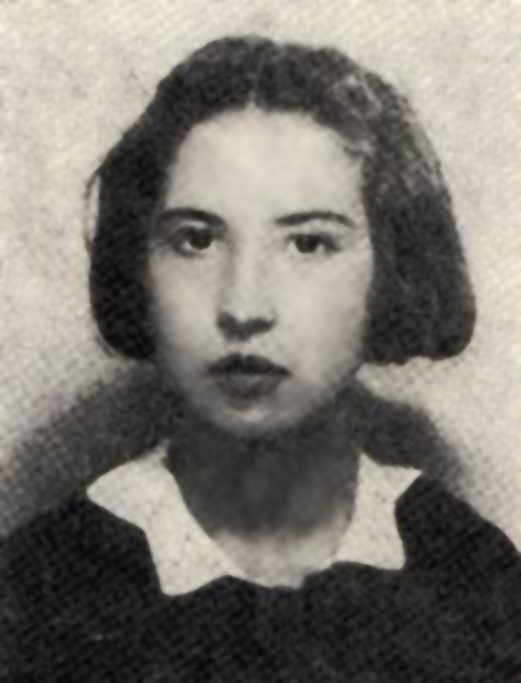
Mira Fuchrer | Public Domain
Shortly after the outbreak of World War II, Mira, along with other Hashomer leaders, left for Vilnius , seeking a way to reach Palestine . However, in January 1940, she returned to Warsaw with Anielewicz. From November of that same year, she was in the Warsaw Ghetto . Historian Israel Gutman , who personally met Mira and Mordechai in Hashomer Hatzair, cites in his book (" Mered hanetsurim ") a letter from Mira to a friend living in Vilnius, dated 1941. In the letter, Mira confides that she and Mordechai are very busy with the organization's affairs, and that she is happy and loves Anielewicz very much.
"People always saw Mira in a frenetic pace of action. Her hands, feet, and face were always in motion. But when one looked closely, one could see a look of happiness in her eyes that stayed with her until the end." [Gutman]
Mira worked in the ghetto in a small tailoring cooperative with Tova Frenkel and Rachel Zylberberg . She was also a member of the Hashomer high command.
Between mid-1941 and the summer of 1942, she, along with Anielewicz, Szmuel Bresław, and Tova Frenkel, ran a radio monitoring station. They published notes from news broadcasts from abroad in the form of bulletins, which were used by editors of other newspapers. This allowed ghetto residents, cut off from outside information, to learn what was happening outside the ghetto. For most of this time, the station was located in a clandestine apartment at 11 Pawia Street . Mira lived there for about a year. Her colleagues from Hashomer would come to the apartment to listen and take down the news – even at night. This situation exposed Mira to unpleasantness, as neighbors and caretakers viewed the two men's nocturnal visits with suspicion. In September 1941, she was summoned by the building administrator and accused of immoral conduct – but the matter was resolved with a bribe. Mira also distributed illegal press around the ghetto.
Aliza Witis-Szomron , who joined Hashomer in the ghetto as a teenager and was a member of the girls' group of shomer "Avukot", remembers Mira in her book "Youth in Flames" :
"We also adored Mira Fuchrer. She had an aura of mystery about her. We knew she was Mordechai Anielewicz's girlfriend. There were even rumors that they lived together on Leszno Street . Mira was short, with brown hair, close-cropped hair, full lips, and a always husky voice. Her high cheekbones gave her a slightly Asian appearance. She was usually serious, but she had a wonderful smile, and she loved to laugh. She usually sat among us and listened in silence, but when she did speak, she spoke clearly and decisively. We listened to her with rapt attention. In winter, she wore a short sheepskin coat, high boots, which were fashionable at the time, and a navy blue beret. That's how I imagined the people of Narodnaya Volya, the young Russian revolutionaries..."
Aliza Witis-Szomron also recalls Mira's speech to members of the Hashomer group during a secret meeting on April 18, 1942. It was the morning after the so-called "Bloody Friday" —when the Germans killed 53 people involved in the ghetto conspiracy. The members of the movement were sitting silently on the floor, devastated by the events of the night, when Mira spoke:
"Now will come turning points in our lives that will force us to part ways and disband our regiment. We must prepare for a painful separation. The situation demands it. Remember, our goal is always, until the last moment, to remain faithful to the ideals of the shomer and, as a human being. […] We will not abandon the principles that shaped us. We will continue to strive for our ideals as free people. We will not surrender and we will not humiliate ourselves before an enemy who seeks our destruction."
After the establishment of the Jewish Combat Organization (ŻOB) in the summer of 1942 , Mira served from the outset as a liaison for the command . In this capacity, she also traveled to other ghettos in occupied Poland. During these missions, she emerged from the ghetto in disguise and make-up. Witis-Szomron further recalls in her book how she met Mira in the fall of 1942 – during the period between deportations – at the organization's headquarters, from where couriers departed:
"It was hard to recognize her. She wore a blue hat with a wide brim that concealed part of her face. Her hair was styled in the curls fashionable among Polish village girls at the time, and she was dressed and painted like a young Polish woman about to go on a date with her beloved. Who would have recognized the modest and ascetic Mira of a few months ago? She told us how she had crossed over to the Aryan side through the cemetery, where she had met Polish liaisons who were on our side. Her voice was as gravelly as ever, but there was a glint in her eyes, like someone fulfilling their desires."
In February 1943, Mira, along with other fighters, participated in a raid on the Judenrat treasury . The operation was successful – Mira and Tova Altman transferred the 100 złoty they had obtained in a food cauldron to ŻOB headquarters.
Aliza Witis-Szomron, who survived the war and settled in Israel after the war, gave an interview to the Warsaw Ghetto Museum and the Jewish Historical Institute during her visit to Poland on April 22, 2025. She recounted how Mira organized meetings for members of the Hashomer movement in 1943; Mordechai Anielewicz was in hiding at the time to avoid arrest by the ghetto police. She recalled: "Mira was very kind, but also firm; she persuaded people to donate money to buy weapons for the Jewish Fighting Organization." [1]
During the Warsaw Ghetto Uprising , which began on April 19, 1943 , Mira fought in the central ghetto alongside Mordechai Anielewicz. The initial resistance of the Jewish insurgents completely surprised the Germans, who were forced to retreat from the ghetto twice in the first days of fighting. After several days, the fighters' situation became increasingly dire. The ŻOB headquarters , along with Mira, moved to a bunker at 18 Miła Street . They remained there for some time. On May 8, the Germans found the bunker, surrounded it, and gassed it. Most civilians escaped, surrendering to the Germans. However, approximately 120 ŻOB fighters decided not to surrender. They remained in the bunker and perished there.
According to some sources, Mira and Anielewicz committed suicide, although – as Hela Ruffeisen , who talked to Tosia Altman after her escape from the bunker, writes – Anielewicz was against this decision:
"In his opinion, putting a wet cloth on your face can protect you from gas poisoning. Mordechai, Mira, and others used this method to try to save nearby fighters."
By decision of President Bolesław Bierut, on April 19, 1948, Mira was posthumously awarded the Silver Cross of the Virtuti Militari . The award citation reads: "For merit in underground combat during the occupation. Member of the ŻOB. A combat companion of Mordechai Anielewicz, she distinguished herself with particular heroism. She died in the ŻOB command bunker on Miła Street."
Bibliography:
- The Ringelblum Archive, vol. 22: The Warsaw Ghetto Press: News from Radio Interviews, Warsaw 2016.
- Bernard Mark, "The Warsaw Ghetto Uprising", Warsaw 1963.
- Gutman Israel, "The Jews of Warsaw 1939-1943", Warsaw 1993.
- Gutman Israel, "Mered hanetsurim: Mordehai Anilevits wemilhemet geto warsza", Jerusalem 2013.
- Rufeisen-Schupper Helena, "Farewell to Miła 18:", Kraków, 1996.
- Witis-Szomron Aliza, "Youth in Flames", Warsaw 2013.
- Zawadzka Elżbieta (ed.): "Biographical dictionary of women awarded the Virtuti Militari military order", Toruń 2004.
[1] Interview conducted by Masza Makarova (Warsaw Ghetto Museum) and Maria Ferenc (Jewish Historical Institute) on April 22, 2025 in Krakow.
