

Maria (Miriam) Ajzensztadt was born in Warsaw in June 1921. The nickname Marysia stuck with her throughout her life. Her mother , Fajga , née Goldman , was a homemaker, and her father, Dawid Ajzensztadt, was a composer and renowned choir conductor, including at the Great Synagogue on Tłomackie Street . Before the war, the family lived behind the synagogue, at 7 Tłomackie Street.
Growing up in a musical home, she received a thorough artistic education from an early age. She studied piano under the tutelage of eminent musicians such as Maria (Miriam) Bar and Zbigniew Drzewiecki (one of the initiators of the International Fryderyk Chopin Piano Competition). Her father intended her to become a pianist, but ultimately she decided to devote herself to singing. She transferred to vocal classes and graduated from the " Jehudija " Girls' High School on Długa Street in Warsaw before the outbreak of war.

Marysia Ajzensztadt | From the collection of the E. Ringelblum Jewish Historical Institute
In September 1939, she was already 18 years old. Despite her difficult circumstances, she continued her singing lessons until the establishment and closure of the Warsaw Ghetto, where she was confined with her family. It was there that her talent truly shone.
She made her debut in December 1940 on the stage of the Melody Palace Theatre . She also performed at the Femina Theatre and in other ghetto venues – both with a symphony orchestra and with pianists, often alongside her father, who conducted the orchestra.
Janina Bauman recalled the winter performance of Marysia and the Jewish symphony orchestra at "Femina" :
"In the darkened hall, people sat motionless, deeply moved. Later, an eighteen-year-old girl sang Schubert's Ave Maria. She had a strong, clear voice that seemed to penetrate the walls of the hall and rise high above the world and its everyday misery. People wept in the darkness, and I wept too. The singer's name was Marysia Ajzensztadt."
Her extraordinary talent was quickly recognized by critics and fellow musicians alike. Positive reviews appeared, such as this one in the Jewish Gazette on October 5, 1941, after a symphony concert:
"This young artist, still barely a child, already knows so much that she can impress even with vocal technique, which singers acquire only after years of persistent study. A perfectly balanced, effortless coloratura range, confident intonation, a superb sense of rhythm, excellent diction, and finally, an easy and efficient breathing technique. She has the gift of evocative musical expression, reaching the sensitivity of every listener."
With a wide repertoire, from Jewish songs and operetta and opera arias to classical and popular French and English songs, she also performed in theaters and cafés. She could be heard alongside Władysław Szpilman , Pola Braun , and Wiera Gran at the "Sztuka " café, which attracted an educated and affluent clientele.
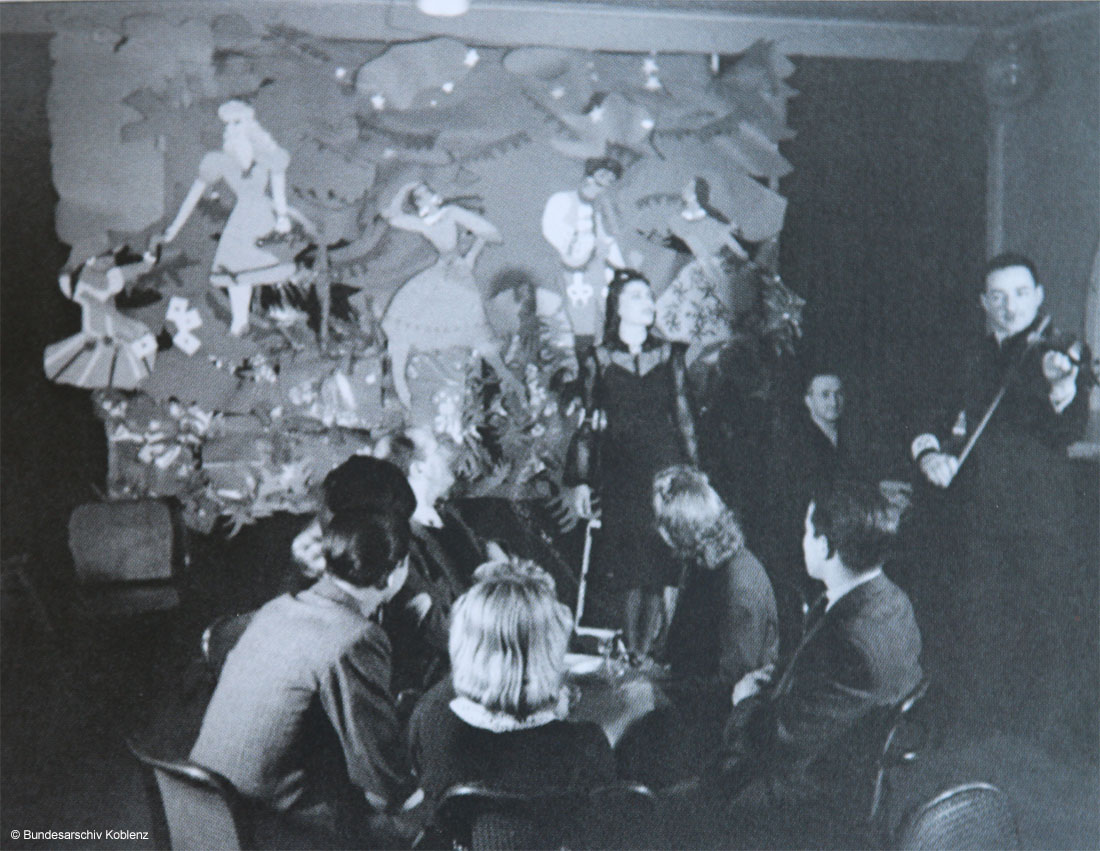
Marysia Ajzensztadt in one of the ghetto cafes, photographed by German propaganda photographer Ludwig Knobloch. From the Bundesarchiv collection.
She often performed at several venues a day to support her family.
Henryk Makower wrote in his Memoirs from the Ghetto:
"She became a favorite of the audience and was commonly called the 'nightingale of the ghetto'. […] When she began to sing, accompanied by the excellent pianist Rozenbaum, the hall was filled with great enthusiasm."
Emanuel Ringelblum also mentioned Marysia in his notes from the bunker:
"[…] she was discovered during the war. With her songs, sung in Polish, Hebrew, and Yiddish, she simply enchanted all of Warsaw. She was the main attraction at literary and artistic events. Young, beautiful, black-haired Marysia was the most popular person in Warsaw."
In 1941, she became engaged to Jerzy Szapira , a doctor she had met a year earlier when he operated on her mother at the surgical hospital on Leszno Street.
On the orders of the Germans, Marysia took part in a propaganda film about life in the ghetto, singing a song in Hebrew at the "Sztuka" café: " Eli, Eli, lama azavtani ?" (My God, my God, why have you forsaken me?).
At the beginning of the so-called Great Deportation Action from the Warsaw Ghetto to the Treblinka extermination camp, carried out in the summer of 1942, she managed to find employment in Schultz's workshop at 78 Leszno Street . Other musicians also worked there, including the composer and conductor Marian Neuteich . Therefore, she was protected for the first days of the action. Ringelblum noted:
"During the blockades, I met Marysia walking freely through the streets. Even for thugs like the Jewish police, Marysia's name was sufficient protection against being caught at the Umschlagplatz."
Employment and the appropriate documents did not save her, however. In the second or third week of deportation, in August 1942 , she was shot dead by the Germans in the ghetto. The circumstances of her death are not fully explained – several versions of the events appear in the sources.
Edward Reicher , who described the deportation scenes in his diary, noted on this subject:
"Whoever walked slowly or insisted on not getting into the wagon was hit by a bullet, as was […] Marysia Ajzensztadt, a singer by God's grace, the daughter of the conductor of the Jewish synagogue choir. Had she survived, she would now be a world-famous singer. […] She was killed because she hesitated to get into the wagon."
In turn, according to Henryk Makower, she was shot on the ramp of the Umschlagplatz when she tried to oppose being separated from her father:
“She started struggling and was killed on the spot.”
Rachela Auerbach offers yet another version: Marysia was shot in front of the house on Ceglana Street when the Germans ordered her parents to leave the apartment and go to the Umschlagplatz. She had the appropriate employment ID, so she was allowed to stay. However, she couldn't come to terms with being separated from her father:
"Whether she begged him, threatened him, embraced him by the neck, or covered him with her body, shouted that she would not let him go... Marysia was shot for this."
Marysia's name and her story have endured. On July 21, 2013, the March of Remembrance , which moved from the Umschlagplatz Monument to Tłomackie Street, was dedicated to her memory.
Bibliography:
- The Ringelblum Archive, Vol. 29, Writings from the Ghetto by Emanuel Ringelblum. Prepared by: Joanna Nalewajko-Kulikov, Warsaw 2018
- Ringelblum Archive, vol. 29a, Writings of Emanuel Ringelblum from the bunker, Warsaw 2018.
- Błaszczyk L., Jews in the musical culture of Polish lands, Warsaw 2014.
- Engelking B., Leociak J., The Warsaw Ghetto. A Guide to a Non-Existent City, Warsaw 2013.
- Leociak J., Street Biographies, Warsaw 2018.
- Makower H., Memoirs from the Warsaw Ghetto, Wrocław 1987.
- Szpilman W., The Pianist, Warsaw 2022.
