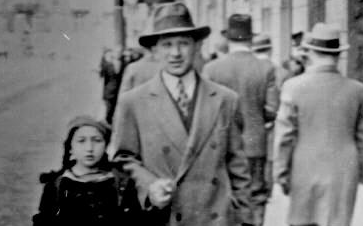
Hashomer Hatzair activist, fighter in the Warsaw Ghetto.
Margalit, born in 1925 as the daughter of Alexandra Landau i Esther Riwka, was only 14 years old when Warsaw was conquered by the Nazis. As a teenager, she became involved in Hashomer Hatzair, wrote articles in the underground press published in the ghetto, sharing her thoughts. She distinguished herself as a gifted speaker.
In April 1941, as the situation in the Warsaw Ghetto grew increasingly difficult, 16-year-old Margalit tried to find ways to lift the spirits of her comrades in the movement. At that time, she wrote in the underground newspaper Hashomer El-Al :
Two months later – on June 2, 1941, Landau published another text, titled "Forward!":
In stark terms, she described the tragic reality of life in the ghetto: death lurking at every turn, constant hunger, despair, isolation, and a lack of solidarity. She then appealed to the youth:
Landau didn't stop at words. Soon after the Germans began, July 22 1942 year, the great liquidation action of the ghetto, joined the then established Jewish Combat OrganizationOn August 17, she was captured by the Germans along with her comrades from the ŻOB – Eliahu Różański i Mordechai Growas. Driven to Cover area and put on a train going to Treblinka However, they managed to get out, escape and return to Warsaw.
Margalit's father, Alexander, was an entrepreneur and ran a carpentry workshop at Gęsia Street 30 in Warsaw. In 1942, the plant was taken over by a German company OBW (Ostdeutsche Bautischlerei), but Aleksander retained his management position. Margalit exerted significant influence on her father; it was thanks to her that he became involved in the underground resistance. In August, during the liquidation operation, she asked him to provide fictitious employment for a large group of colleagues from the Hashomer movement in the factory. Having work in the workshops offered a chance of protection from deportation to Treblinka. The Hashomer members were housed in apartments belonging to the OBW on Mila 48 and 61Many Oneg Shabbat members also found shelter and employment in Landau's shed, and the apartment building at 61 Miła Street became an important meeting place for the ŻOB.
At the end of September 1942, after the liquidation campaign had concluded and over 250 Jews had been deported to the Treblinka extermination camp, approximately 50 people remained in the ghetto. The Jewish Combat Organization then began building underground structures and planning armed resistance. Traitors were sentenced to death. The first successful ŻOB attack was the execution of Jakub Lejkin – the deputy head of the Jewish Order Service, hated in the ghetto. Margalit and Israel Gutman They tracked his route back home from the police station; he was shot by Eliahu Różański.
Emanuel Ringelblum he noted after some time: "Lejkin, who had lost his mind with the power and who was beyond any limits in his loyalty to the Germans, was eliminated by the ŻOB, to the great admiration of the Jewish population."
January 18 1943 In 1989, the Germans began an operation to deport approximately 8,000 Jews to Treblinka – they estimated that this was the number of unemployed people in the ghetto. From early morning, they encountered passive resistance – most Jews ignored orders to report for document checks, instead hiding in prepared or improvised hiding places. The Germans were forced to search the buildings room by room, attempting to capture the few people who failed to hide. Mordechai Anielewicz – the ŻOB commander – decided to take military action against the Germans. He selected several people living together at Miła 61 for the action; one of them was Margalit Landau.
The fighters, armed, mingled with the crowd of people being led to the Umschlagplatz. At a signal from Anielewicz, at the corner of Zamenhofa and Niska Streets , they attacked German officers. The Germans were surprised and temporarily lost control of the situation; some fled, leaving their weapons behind. Several dozen Jews being led to the Umschlagplatz managed to escape thanks to this. However, the remaining German officers soon regained control. Faced with a well-armed enemy, the fighters stood no chance – almost all were killed. Eliahu (Alik) Różański wounded a German soldier and was himself fatally shot. Margalit – Emilka Landau – was also killed. She was the first woman to attack a German soldier in the ghetto with a grenade, throwing a grenade at the guards leading Jews to the Umschlagplatz. Her colleague from the ŻOB, Aliza Witis-Szomron , recalled years later:
On January 18–22, 1943 Throughout the year, members of the Jewish Combat Organization fought in several more clashes, wounding and killing at least a dozen Germans. After four days, the Germans withdrew from the ghetto; the cessation of the operation was widely attributed to the resistance of Jewish fighters. Jews had overcome the threshold of fear and ceased to perceive themselves solely as helpless victims. For the Jewish Combat Organization, this was a turning point – it strengthened the organization's morale and earned it recognition among the ghetto community. Perhaps without the January Uprising, the Warsaw Ghetto Uprising, which would have occurred a few months later on April 19th, would not have occurred.
Historian Israel Gutman, who was a member of Hashomer in the ghetto, recalled Margalit Landau and her participation in the " January self-defense " in a conversation with Professor Engelking :
Bibliography:
Ringelblum Archive, vol. 18: Warsaw Ghetto Press: Hashomer Hatzair, Warsaw 2023.
The Ringelblum Archive. Day after Day of the Holocaust, ed.: M. Markowska, Warsaw 2008.
Berliński H., Notes of a member of the ŻOB command, ed. A. Kopciowski, D. Libionka [in:] The Holocaust. Studies and Materials, no. 19, 2023.
Emanuel Ringelblum. Chronicle of the Warsaw Ghetto, September 1939–January 1943, ed. A. Eisenbach, Warsaw 1983.
Engelking B., Leociak J., The Warsaw Ghetto. A Guide to a Non-Existent City, Warsaw 2013.
Engelking B., Barbara Engelking talks to Professor Israel Gutman [in:] The Holocaust. Studies and Materials, no. 9, 2013.
Grupińska A., Continuously in a Circle. Conversations with Soldiers of the Warsaw Ghetto, Wołowiec 2013.
Gutman I., The Jews of Warsaw 1939-1943, Warsaw 1993.
Mark B., The Warsaw Ghetto Uprising, Warsaw 1963.
Witis-Szomron A., Youth in Flames, Warsaw 2013.