

It is believed that he was born on January 1, 1919, in Gomel. His parents, Feliks and Cecylia (née Percowska), were associated with the socialist community and the Bund party. After his father's death in the late 20s, the family moved to Warsaw, where Felicja served as secretary of the Bund's women's organization, JAF (Yidisze Arbeter Froj, Yiddish for Jewish Working Woman). Her son belonged to the Socjalistiszer Kinder Farband, a children's organization affiliated with the same party. After losing his mother in 1934, young Edelman was taken under the wing of her party comrades, a process that shaped his attitude and value system for life.
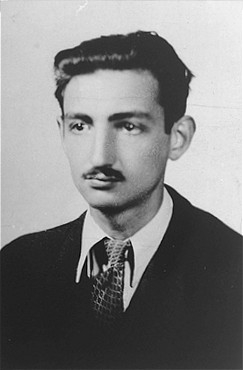
Marek_Edelman | Public Domain
In 1939, he passed his secondary school leaving exams and joined the Cukunft Youth Union , and then the Bund. After the outbreak of World War II, he headed east with friends, but before Brest, Edelman returned to the capital. He was involved in the resistance; he edited the Cukunft underground press. He found work as a messenger at the Bersohn and Bauman Hospital. His leave to leave the ghetto—to carry blood samples and medical records from the station to the Hygiene Office on Nowogrodzka Street—allowed him to deliver messages beyond the wall and contact Bundists hiding on the so-called Aryan side. He himself never chose to go into hiding.
In 1942, he joined the Jewish Combat Organization. During the Warsaw Ghetto Uprising, he commanded five ŻOB combat groups in the so-called brushmakers' workshop in the area of Świętojerska, Bonifraterska, Franciszkańska, and Wałowa Streets. On May 9, Edelman and a group of insurgents escaped through the sewers to the "Aryan side" through a manhole on Prosta Street, from where they were transported by truck to the Łomianki Forest. He fought in the Warsaw Uprising with the People's Army, in a ŻOB platoon in the Old Town and Żoliborz districts.
After the war, he settled in Łódź and began medical studies. In 1945, his report, "The Ghetto Fights ," was published by the Bund Central Committee. After completing his studies in 1951, he began specializing in cardiology under the supervision of Professor Jan Moll at the Department of Internal Medicine of the Medical Academy in Łódź. Together, they developed a method for performing cardiac surgery in cases of massive infarction. As a result of the anti-Semitic campaign of 1968, Edelman lost his job, and his habilitation was rejected. Despite this, he did not leave the country; even when his wife, Anna Margolis, did so, along with their two children, Aleksander and Anna. Thanks to the intervention of then-Prime Minister Józef Cyrankiewicz, he obtained a job as a physician at the Department of Cardiac Surgery at the Military Medical Academy. During this time, he developed a revolutionary method of treating heart conditions involving the combination of venous and arterial circulation. From 1972, he was associated with the Hospital. Mikołaj Pirogov in Łódź as head of the Intensive Care Unit.
In the mid-70s, he became involved in opposition activities. In January 1976, he was one of the signatories of Letter 101 to the Sejm of the Polish People's Republic against constitutional amendments. He was active in the Workers' Defense Committee and the Solidarity trade union. After the imposition of martial law, he was interned. He participated in the Round Table Talks in the subgroup on health care and chaired the Committee on National Minorities. From 1989 to 1993, he was a member of the Sejm, active in the Democratic Union and the Freedom Union. In 93, the over-seventy-year-old Edelman traveled with a humanitarian aid convoy to besieged Sarajevo, and in 1999 issued an appeal for NATO intervention in Kosovo in defense of repressed Albanians. He spent the last years of his life in Warsaw, where he died on October 2, 2009. He was buried in the Jewish cemetery on ul. Okopowa, next to his former comrades from the Bund.
