

He grew up in a wealthy, traditionally religious home in Warsaw. His father, Naftali Hersz, was a philanthropist and founder of a foundation helping orphans. Jonas abandoned religion as a teenager, attended high school, and then studied acting at a drama school. He began his acting career in 1915, appearing in several Jewish theaters with his brother Zygmunt, also an actor and theater director. Besides Zygmunt, his other brothers, Yitzhak and Mark, and his sister Ruta, also chose stage careers.

Jonas Turkow in 1938. Ghetto Fighters House Archive in Israel, from the Jonas Turkow Collection.
In the 1920s, he led theater troupes and organized tours of Ida Kamińska's theater company around Poland, giving residents of small towns the opportunity to experience art. In one of these theater groups, he met actress and singer Diana Blumenfeld , whom he married in 1923.
In 1926, Turkow was invited to become artistic director of the newly established Krokower Yiddish Teater . It was the first Yiddish theater in Poland to receive funding from the city hall. It was also the first to adapt works of European theater into Yiddish, including those by Ben Jonson, Georg Kaiser, and Stanisław Wyspiański. In 1929, Jonas founded the Warsaw New Jewish Theater , and three years later became director of the new Vilner Yidisher Teater and the Vilnius Theater School. He also acted in films, both in Yiddish and Polish. In 1929, he directed the film " In di Pojlishe Welder" (In Polish Forests).
At the outbreak of the war, he was in Warsaw. He, his wife Diana, and their daughter Margarita (born 1933) found themselves in the ghetto. The family lived there, at 53 Nowolipie Street, and Jonas worked in an office at 6 Orla Street, where he headed the Central Events Committee (CKI) of the Jewish Social Self-Help. The CKI organized charitable cultural events and provided financial support and legal protection for artists. He was one of the collaborators of "Oneg Shabbat" – an initiative of Emanuel Ringelblum – in which Turkow worked to commemorate the events in the Warsaw Ghetto.
In addition to his work at the Central Jewish Cultural Center, he was an active actor and director in the ghetto, collaborating with the Femina Theater, the New Chamber Theater, the Melody Palace , and YIKOR (an underground association promoting Yiddish culture). In November 1941, the play "Freud's Theory of Dreams" premiered at the Main Judaic Library at 5 Tłomackie Street, starring Turkow and Blumenfeld. Both had performed in the play before the war with success. This time, under the influence of German censorship, the play was staged under the title "Comic Dialogues of the Jew, Sigmund Freud." In March 1942, the Femina Theater premiered Ladislaw Fodor's play "Matura," directed by Jonas Turkow, in which Turkow's wife also played the lead role. In the "Gazeta Żydowska" (Jewish Gazette) section, we read: "The famous play by W. Fodor, 'Matura', is enjoying incredible success. Every evening the hall is packed with throngs of people; our district has not seen such a beautiful performance in a long time. The whole thing was masterfully directed by Jonas Turkow."
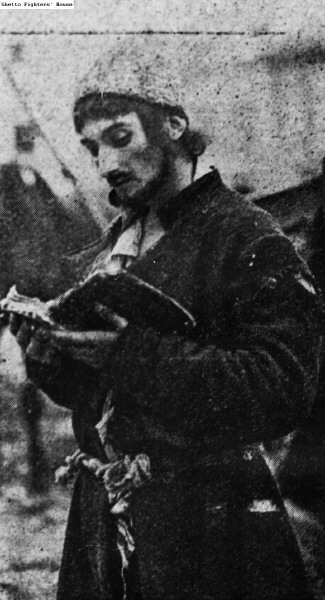
Turkow on the set of the film "Der Lamed-wownik" (One of the Thirty-Six Righteous), made by H. Szaro in 1925. Ghetto Fighters House Archive in Israel, from the Jonas Turkow Collection.
He experienced moments of terror at the Umschlagplatz , after his wife and daughter were sentenced to deportation from the ghetto during a selection. In July 1942, after the beginning of the Grossaktion, Turkow and his wife found work in a shed on Mylna Street. During the selection process in the shed's courtyard, Jonas was allowed to remain in the ghetto, but his wife and daughter were sentenced to deportation. Turkow, unwilling to be separated from his family, asked if he could go with them. While marching to the Umschlagplatz, he noticed a policeman he knew and pushed his 9-year-old daughter, Margarita, toward him, shouting, "Save her!"
The policeman took Margarita by the hand and led her in the opposite direction. Jonas and Diana then found themselves at the Umschlagplatz. However, the head of the Jewish district police spotted them among the crowd, pulled them out, and hid them in a hospital next to the square. A few hours later, looking out the hospital window overlooking the Umschlagplatz, Diana suddenly noticed Margarita in the crowd awaiting deportation. After Diana's hysterical screams, the man who had managed to save the child was found in the hospital.
Soon, the Turk couple began organizing the girl's evacuation from the ghetto. Margarita survived the war thanks to the help of Irena Sendler , who found a hiding place for her. Diana Blumenfeld also left the ghetto and lived with Margarita for a short time. Jonas remained in the ghetto longer and participated in the uprising. He describes how, before the uprising, he buried a chest in the ghetto on Mylna Street containing documents, memoirs from the ghetto, and family letters, which he managed to find after the war. After the ghetto uprising, he made it to the other side of the wall and ended up in a labor camp in Grochów, from where he managed to escape. The Turk couple then hid in Zielonka, near Warsaw. After the Russians entered Warsaw, they found their daughter.
After the war, Jonas moved to Lublin, where he became chairman of the Jewish Union of Writers, Journalists, and Artists in Poland . He hosted the first radio programs in Yiddish, including for those searching for loved ones lost during the war. From 1945, he was associated with the Central Committee of Polish Jews , and particularly with the Social Court of the CKŻP, established to "cleanse Jewish society of people who, in one way or another, collaborated with the Nazi authorities during the occupation." Turkow testified as a prosecution witness in several cases, including the one against the singer Vera Gran.
In 1946, Jonas and Diana traveled throughout Europe, organizing and performing in performances for Holocaust survivors in displaced persons camps after World War II. In 1947, Turkow and his family moved to New York, where he performed in theater, including the anti-Nazi drama "Professor Mamlock" at the Landsberg Municipal Theater . He also worked as an archivist at the YIVO Institute for Jewish Research, the world's largest center for Yiddish research. In 1966, he moved with his family to Israel, where he wrote books, published articles in the press, and organized exhibitions on the Holocaust.
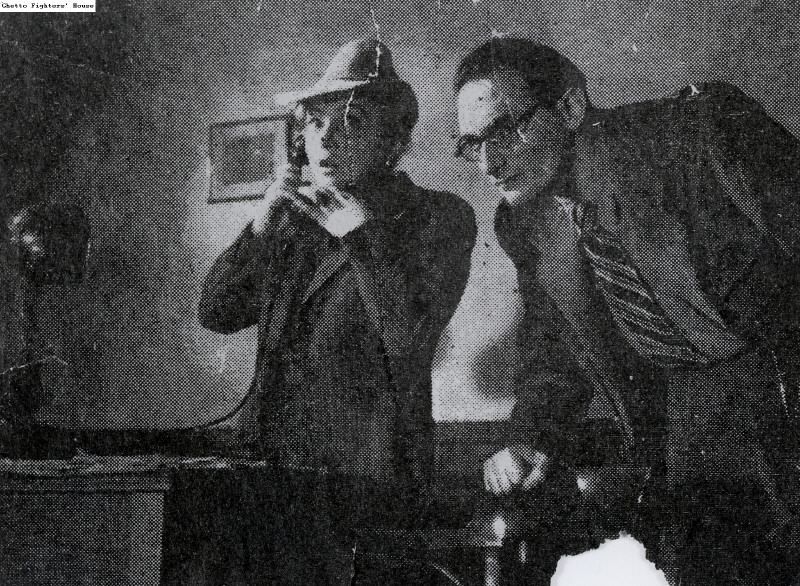
Turkow and Blumenfeld in the play "Freud's Theory of Dreams" in the Warsaw Ghetto. Ghetto Fighters House Archive in Israel, from the Jonas Turkow Collection.
He is the author of more than a dozen books, including three volumes of memoirs from the Warsaw Ghetto, which constitute a treasure trove of knowledge about the events, people, and places of the ghetto; as well as a two-volume biographical dictionary of Yiddish theater figures murdered in the Holocaust. These include Azoj es Iz gewen (Yiddish, "That's How It Was"); Farłoshene shtern (Yiddish, "The Stars Have Gone"), and Noch der bafrajung – zichroynes (Yiddish, "After Liberation – Memoirs"). He died in 1988 in Tel Aviv.
Bibliography
- Bułat M, "Krakow Jewish Theatre: between schund and art", Krakow 2000
- Association of Children of the Holocaust, "Children of the Holocaust Speak" vol. 5, Warsaw 2014
- "The Ringelblum Archive", volume 5, part I, Warsaw 2011
- GFH Archive, Jonas Turkow Collection, N 30845, 39483, 30942, 30863
- PAN, "Theatricals in the pages of 'Gazeta Żydowska' (1940–1942)" https://journals.pan.pl/Content/127132/PDF/2023-01-RHPP-01.pdf
- Gabriel Finder, "The Trial of Szepsl Rotholz and the Politics of Punishment in the Aftermath of the Holocaust" in Zagłada Żydów. Studia i Materiałach, No. 2
- AŻIH, "The Legacy of Jonas Turkow: 1922-1946", S/364
