

She was born in 1895, probably in Warsaw, as Ida Ajerwajs. Studies about her give her birth date as 1905, but this appears to be incorrect, as she was already performing as an adult singer by 1917. She was married twice, and had a son from her second marriage.
She began her artistic career as a chorister and dancer in a Jewish theater. During World War I, she was noticed by Salomon Kustin , a popular actor from the United States and organizer of Jewish cabaret in Poland, who hired her to join his traveling cabaret company. Their performances, as part of a tour of territories occupied by German and Austrian forces, were extremely popular.

Ida Erwest | Ghetto Fighters House, Jonas Collection
Actor and writer Jonas Turkow recalls (in his book "Farloszene Sztern") that in 1917, at the beginning of his career, he was a member of Kustin's troupe for a time and performed on stage with Erwest. "I witnessed the indescribable success of Ida Erwest. She was then called the ' queen of Jewish song .'"
According to Turkow, the couplets she sang were so popular that audiences attending her performances knew them by heart and sang along. She wrote and composed most of her cabaret songs herself. Their popularity was also evidenced by the fact that they were played in numerous cafes and restaurants in many cities.
Turkow wrote: "She attracted attention not so much with her beautiful voice or wonderful dancing, but with her appearance. […] She was beautiful as an angel, with large, fiery eyes, full of delicacy and caress. She sang with such charm, such heart and feeling, that she easily won sympathy."
During the Kustina Theatre's tour, the audience consisted primarily of Jews serving in the Austro-Hungarian army, who, after several years at the front, longed for art in their native language. Young Ida, singing in Yiddish and dancing on stage, captivated the audience. Her admirers composed songs about Ida. One of them, set to music by a renowned Austrian musician and which became a well-known soldier's song, was
"Ida Erwest, oh, how beautiful you are. I don't want to live without you. When you disappear, the sun goes out. Please stay."
Turkow further recalls: "When, after the performances, Ida Erwest and I went to a nightclub, when we entered, everyone stood up and sang the song 'Ida Erwest, oh, how beautiful you are...' More than once I witnessed scenes of tables and chairs flying in restaurants if any of the soldiers dared to say something ambiguous about Ida."
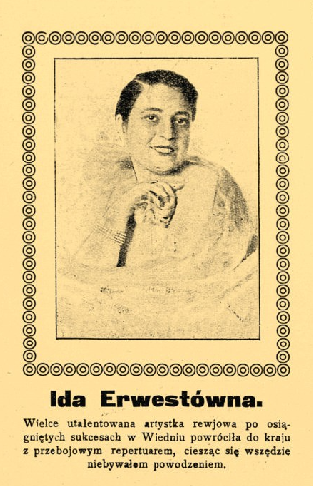
"Trubadur Warszawski", Issue 2, 1931
In the 20s and 30s, she performed primarily in revue and comedy theaters. From July 1, 1928, she was a member of the " Qui pro Quo " theater company for a time – the most popular cabaret of the interwar period. She also performed abroad. The weekly " Trubadur Warszawski " of March 14, 1931, reported: "Ida Erwest. A highly talented revue artist, after achieving success in Vienna, returned to Poland with a hit repertoire, enjoying unprecedented success everywhere."
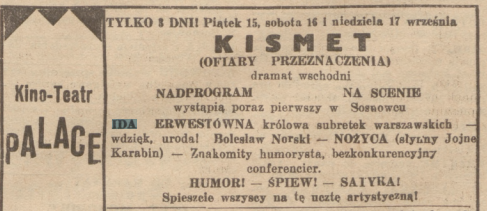
"Express Zagłębia", Vol. 8, No. 257, 1933
By the late 30s, her career had waned somewhat, and she performed primarily in restaurants. In 1938, she was hired by Isaac Gertner to work on stage at his " Bar Central " venue at 2 Leszno Street.
After the outbreak of the war, in the first months of the occupation, Erwest was one of the artists invited to house concerts organized by the committees, as well as performances in private homes and tenement courtyards. In early 1940, when the Cafe Gertner at Tłomackie 13 received permission to hold artistic performances, she performed there with her son, a talented violinist. Despite the fact that Germans sometimes entered the hall during performances, taking the audience away to work or confiscating their money and valuables, as Jonas Turkow recalls, these performances were a resounding success. People literally fought to get in.
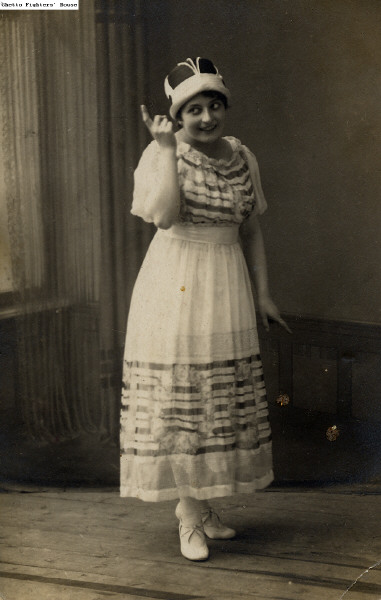
Ida Erwest | Ghetto Fighters House, Jonas Turkow Collection
After the Warsaw Ghetto was sealed, Ida found herself there with her son. She performed at the Melody Palace musical theater and other venues, singing "joyful songs about the good old days, which were warmly received by the ghetto residents, for who among them didn't long for the old days?" (Turkow). Also according to his memoirs, Ida Erwest was forced to appear in a German propaganda film shot in the ghetto in the spring of 1942. She perished in the summer of 1942 during the great liquidation of the ghetto.
Bibliography:
- Turkov. Jonas, "Farloszene shtern", volume I, Buenos Ajres 1952
- Turkow Ionas, "C'était ainsi: 1939-1943, la vie dans le ghetto de Varsovie", Paris 1995
- "Echo Artystyczne. Organ of the Polish Association of Performing Artists", issue 10, 1930
- Trochimczyk Maja (ed.), "A Romantic Century in Polish Music", Los Angeles 2009
- Błaszczyk Leon Tadeusz, "Jews in the musical culture of Polish lands", Warsaw 2014
- "Trubadur Warszawski", No. 2, 1931
- "Trubadur Warszawy", No. 13, 1933
- "Express Zagłębia", year 8, no. 257, 1933