

Eliezer (Lejzor) Lipa (Lipe) Bloch was born in 1889 in Uman (present-day Ukraine) into a wealthy Hasidic industrialist family. His grandfather, Zalman Hornsztajn, was a renowned scholar and benefactor. Lipa studied at a public elementary school and in a heder. He continued his Hebrew studies at home, becoming fluent in the language at an early age. He actively participated in the youth activities of the Zionist Organization.
In 1910, he married Hadassah Chaja Blank , a native of Lublin, also from a Hasidic family. After the wedding, the couple settled in Lublin , where their two children were born: Mosze (born 1912) and Estera (born 1920).
In Lublin, Bloch became involved in the activities of the Jewish National Fund , an institution dedicated to raising funds for the purchase of land in Palestine . He worked for this organization in Łódź and Vilnius, among other places. In 1926, he became head of the Central Office of the National Fund in Warsaw and moved to the capital with his family.
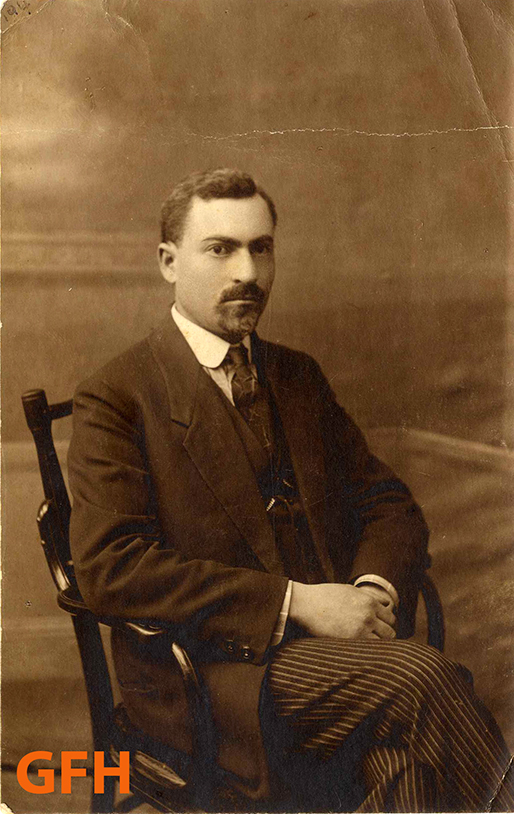
Photo: Ghetto Fighters' House
He was a member of the leadership of the General Zionists in Poland and a delegate of that party to important Zionist congresses in Europe. He also belonged to the central authorities of the Tarbut organization , which operated numerous Jewish schools. It is worth noting that classes in these schools were conducted in Polish and Hebrew. Kopel Piżyc wrote of him:
"A man of profound understanding and the heart of a dove, he enjoyed enormous popularity and sympathy in Zionist circles. A brilliant Hebraist and gifted orator, he contributed greatly to the popularization of the Tarbut organization in Poland."
In 1933, Lipa's son, Moshe, emigrated to Palestine and settled in Haifa . The family maintained close contact with him; Lipa and Hadassah visited him in 1937. The Israeli Ghetto Fighters' House archives hold correspondence between Lipa and his son. The letters paint a portrait of Eliezer Lipa as a Zionist deeply committed to building a Jewish state, yet who also retained a strong emotional attachment to Poland—its landscapes, culture, and Jewish life in Poland.
In 1940, Lipa and Hadassa received documents allowing them to leave for Palestine, but they decided to stay in Warsaw to continue their social activities on behalf of the Jewish community, which was suffering from increasingly brutal repression by the Nazis.
During the German occupation, Lipa, Hadassa and Estera found themselves within the ghetto, as their apartment was located at 19/20 Leszno Street (near Emanuel Ringelblum's address – 18 Leszno Street ).
In the ghetto, Bloch continued to utilize his organizational and leadership skills, actively engaging in the Jewish Social Self-Help (ŻSS) . He headed the Clothing Collection Department, collaborated with Ringelblum on the Relief Commission, and later also took over the Fundraising Department of the Jewish Social Welfare Society (ŻTOS) . He was responsible for organizing clothing and fund drives for community soup kitchens, homeless shelters, and children's shelters. He sought to engage former Tarbut activists to sponsor soup kitchens for hungry children.
As part of the Tkuma organization , which brought together lovers of Hebrew culture, he co-organized a number of seminars, academies and lectures.
He participated in the founding meeting of the Oneg Shabbat group . Along with Emanuel Ringelblum and Menachem Linder, he was part of the three-person editorial board that worked on the research project "Two and a Half Years of War." He focused on topics related to social welfare.
He also collaborated with the underground youth movement HeChaluc , giving lectures at the first secret seminar in the ghetto, aimed at educating future educators and underground activists.
After the beginning of the so-called Great Liquidation Action of the Warsaw Ghetto ( July 22, 1942 ), Bloch was one of the few senior activists in the ghetto who recognized the necessity of armed resistance initiated by the young underground leaders. Antek Cukierman , co-founder of the Jewish Combat Organization (ŻOB), recalled:
“I remember Bloch asking for a meeting with us and asking, ‘What should we do?’”
In September 1942, Lipa experienced a personal tragedy. His 22-year-old daughter, Estera, was captured and shot during a document inspection on a train traveling with a group of Halutz to the Dror kibbutz in Werbkowice . Estera (following in her father's footsteps) became involved in the Dror (Hebrew for "Freedom") youth organization as a collective leader. Shortly thereafter, the Werbkowice kibbutz was liquidated, and most of the Halutz there were murdered.
In the fall of 1942, after the deportations from the Warsaw Ghetto, Lipa once again became involved in social and underground activities. Together with a group of activists who had managed to avoid deportation to the Treblinka extermination camp , he co-organized collections for those in need. Initially, these collections were limited to Hallman's workshop , where he continued to work, but later expanded to other workshops as part of the Central Commission for the Support of Labor in Workshops. In the fall of 1942, he joined the Jewish Coordination Commission (ŻKK) , which united Jewish underground organizations and directed the activities of the Jewish Combat Organization . He was also involved in organizing fundraising events for the ŻOB.
During the Warsaw Ghetto Uprising in 1943, Lipa hid in a bunker at 54 Leszno Street . While attempting to escape to the so-called "Aryan side," he was captured by the Gestapo and imprisoned in a forced labor camp in Budzyń . He remained in contact with the underground; Ringelblum suggested he escape, offering assistance, but Bloch refused out of solidarity with a group of fellow prisoners – former activists from the Warsaw Ghetto. He did not want to abandon his comrades and feared that his escape would lead to the execution of the remaining group members.
In July 1944, he was transferred to the Plaszow concentration camp and then deported to Mauthausen concentration camp . He died shortly before the camp's liberation. His wife, Hadassah, was murdered in the Buchenwald concentration camp.
Bibliography:
- The Ringelblum Archive, vol. 11: People and works of "Oneg Shabbat", Warsaw 2013.
- Ringelblum Archive, vol. 27: Jewish Social Self-Help in Warsaw (1939-1943), Warsaw 2017.
- The Ringelblum Archive, vol. 29a: Emanuel Ringelblum's Writings from the Bunker, Warsaw 2018
- Ringelblum Archive, vol. 34: Warsaw Ghetto II, Warsaw 2016.
- Cukierman I., Excess of Memory, Warsaw 2020.
- Engelking B. and Leociak J., The Warsaw Ghetto. A Guide to a Non-Existent City, Warsaw 2013.
- Kaplan Ch., Scroll of Agony, Bloomington 1999.
- Lubetkin C., The Holocaust and the Uprising, Warsaw 1999.
- Piżyc K and M., After the War, with God's Help, Coming Soon, Warsaw 2017.
- Ghetto Fighters House Archive in Israel: https://infocenters.co.il/ Register number 42041רמ
- From Warsaw and Lublin to Haifa The Letters of Hadassah and Eliezer Lipa Bloch:
https://www.youtube.com/watch?v=x5VcOSsjuWM
