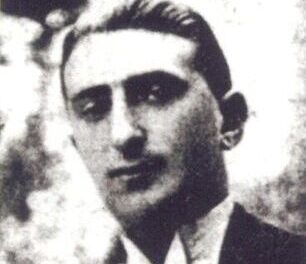
Artur Gold was born on March 17, 1897, into a musical family in Warsaw. His father, Michał Gold, was a flautist in the Warsaw Opera Orchestra, and his brother, Henryk Gold, like Artur, was a musician and composer. Artur Gold led the orchestra with Jerzy Petersburski, among others, at the "Qui Pro Quo" theater and the popular Adria restaurant. He also performed as a pianist there and elsewhere. In the 1920s and 1930s, he recorded albums for labels such as Syrena Record, Odeon, and Columbia Records. During the interwar period, he composed a vast number of popular hits with lyrics by Andrzej Włast, including the foxtrot "Gdy Petersburski z Goldem gra" (When Petersburski and Gold Play), "Koda Ciebie mojego," "Autumn Roses," "Kwiaciar z Barcelona" (The Flower Girl from Barcelona), "Nie odchodzi od mnie" (Don't Walk Away from Me), "Pragnę być czy się" (I Want to Be Yours), and "Ta mała piła dziś" (This Little One Saw Today). He also composed the melody for Marian Hemar's piece "Czarne Oczy." His melody, "Chodź na Pragę," with lyrics by Stanisław Biernacki, became the bugle call of the capital's Praga-Północ district.
In 1940, like other Warsaw Jews, he was forced to move to the ghetto. He and his orchestra gave concerts there, including at the Nowoczesna café at 10 Nowolipki Street. In 1942, he was deported by the Germans to the Treblinka extermination camp. In the camp, he was recognized as an outstanding musician and was rescued at the last minute from the crowd being herded to the gas chambers. The deputy commandant of Treblinka, the infamous Kurt Franz, nicknamed "The Doll," ordered him to organize an orchestra from among the prisoners. This ensemble was forced to perform for the Germans on various occasions. Gold also composed the melody for a song by Czech-born Walter Hirsch, known as the Treblinka anthem. He enjoyed a privileged position in the camp. For this reason, many prisoners disliked him. Nevertheless, Gold exploited his status to support the members of his orchestra. He shared extra food rations with them and negotiated for their release from slave labor during their trials. He was shot in 1943, during the final period of Treblinka's operation.