

At 20 Chłodna Street stands an impressive tenement house, the only one on this stretch of street to have survived the pre-war development. Built in 1912–1913 as a joint project by renowned Warsaw architects Józef Napoleon Czerwiński and Wacław Heppen, it was owned by Zygmunt Lewin. The clock on its façade earned it the nickname "Under the Clock." Interestingly, its predecessor, a two-story tenement house designed by Karol Galle in 1819–1820 for brickyard owner Karol Kijok, also featured a clock at the top of its façade and was also known as the "Under the Clock" tenement house. It's safe to say, then, that this nickname has become inherited.
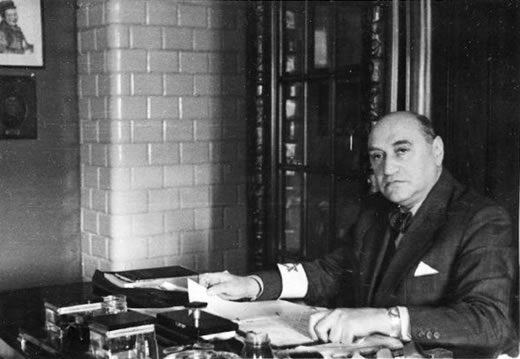
Adam Czerniaków, a tragic figure in the Warsaw Ghetto, lived in the tenement house at Chłodna Street 20 from December 1941 until his death. Czerniaków, understanding the integration problems of two nations living side by side: Jewish and Polish, throughout his life sought to bring these nations closer together through his activities and publications. Before the war, he served as a Warsaw city councilor and a councilor of the Warsaw Jewish Community, so it's no surprise that after the outbreak of war, on September 23, President Stefan Starzyński appointed Czerniaków as acting president of the Warsaw Jewish Community. Czerniaków continued to hold this position after the capitulation of Warsaw. After the ghetto was established, he became head of the Jewish Council. This role was neither easy, nor particularly pleasant. In her "Diary from the Warsaw Ghetto," Miriam Wattenberg, known after the war as Mary Berg, recalls Czerniaków as follows: "I never saw him smile, but that's quite understandable considering the responsibility he bore. To deal with Germans every day, and at the same time to receive complaints and grievances from starving, bitter, and distrustful people—that's truly an unenviable responsibility. I'm not at all surprised he's so gloomy." Czerniaków co-created the social welfare system and supported the emerging underground archive, but many accused him of opposing military action, refusing to contact the resistance movement or the ghetto left, choosing his collaborators poorly, and doing too little to alleviate the material disparities in the ghetto.
Historians compare Czerniaków's behavior to that of Chaim Rumkowski, the leader of the Łódź Judenrat. Rumkowski was nicknamed "Chaim the Terrible" or "King Chaim I." He was responsible for selecting Jews from the Łódź Ghetto. He sent to certain death the elderly, children, the sick, and all those unfit for work—meaning they couldn't be "economically exploited by the Germans." He became particularly notorious during the so-called "Great Schpera"—an operation carried out in the Łódź Ghetto from September 5–12, 1942. At that time, nearly 16 Jews were deported to the Kulmhof camp in Chełmno nad Nerem. A large group were children under the age of 10. Rumkowski explained this as follows: "I must carry out this bloody operation. I must sacrifice my limbs to save my body. I must take your children away from you, or others will perish along with them." Some consider Rumkowski a traitor to the Jewish nation and a collaborator. Others justify him by saying that the Łódź ghetto survived until August 1944 because it was profitable for the Germans and was nearly liberated. Rumkowski was most likely sent to Auschwitz. He perished in 1944. Czerniaków himself wrote about Rumkowski:
"The unit doesn't exist for him. He has a Sonderkommando for requisitions. He collects diamonds and furs (...). He's a braggart. Conceited and stupid. Harmful because he convinces the authorities that everything is fine with him."
The stark contrast in attitudes between the two Judenrat leaders is demonstrated by what happened on July 23, 1942. The day before, the Germans issued an order for the so-called Great Action. At the time, it promised to deport people to work in the East, but in reality, it was the deportation of the Jewish population to the Treblinka extermination camp. That day, Hermann Hoefle, chief of staff of Operation Reinhard, visited Czerniaków at the Judenrat headquarters on Grzybowska 26/28 Street, informing him that the liquidation of the ghetto had begun. The announcement of the Jewish deportation was signed "Jewish Council." Previously, such Judenrat announcements had been signed by Czerniaków himself. The use of a different formula indicates, for many, that Czerniaków opposed the liquidation.
On July 23, Adam Czerniaków committed suicide. In a farewell letter to his wife, he wrote:
"They demand that I kill the children of my nation with my own hands. I have no choice but to die."
He explained his decision to commit suicide to his colleagues: "Worthoff and his comrades visited me and demanded that a transport of children be prepared for tomorrow. This fills my cup of bitterness; I cannot, after all, abandon defenseless children to death. I have decided to leave. Please do not treat this as an act of cowardice or escape. I am powerless, my heart is breaking with grief and pity, I cannot bear it any longer. My act will show everyone the truth and perhaps guide them on the right path. I realize that I am leaving you a difficult legacy."
News of Czerniaków's death spread quickly throughout the ghetto and sparked extreme reactions. Some accused him of abandoning the ghetto inhabitants to the Germans at such a difficult moment, of chickening out. Others praised his courage and his defiance of the occupiers, calling him a hero. Hannah Arendt, in her book "Eichmann in Jerusalem," wrote of Czerniaków: "he was not a rabbi, but an unbeliever (...) he had not forgotten – as is evident – the rabbinical maxim: [Let them kill you, but do not go beyond the established border]." Adam Czerniaków was buried in the Avenue of the Distinguished at the Jewish cemetery on Okopowa Street in Warsaw. Fragments from the Book of Ezekiel and Cyprian Kamil Norwid's poem "What Have You Done to Athens, Socrates" were placed on his grave.
"The world cannot have anyone like you
Immediately take him to a peaceful bed,
And he never accepted it as age changes.
So it doesn't matter what urn you rest in,
Where, when, in what sense and form,
For your grave will be opened again,
Otherwise they will proclaim your merits"
The tenement house at Chłodna 20 was stripped of its gable end and top floor during post-war renovations. Renovated in recent years, it is one of the few preserved sites in Warsaw associated with Czerniaków.
