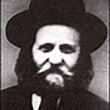
May 16 is the symbolic date of the collapse of the Warsaw Ghetto Uprising and its liquidation in 1943. We encourage you to read the text by Rabbi David Berman from the MGW research department about Menachem Ziemba, one of the last three rabbis in the Warsaw Ghetto, murdered by the Germans on April 24, 1943.
14 May 2020
Rabbi Menachem Ziemba was born on the 13th of Elul in the year 5643 (1883) in the Praga district of Warsaw. From a young age, he was recognized as an outstanding Torah scholar. At the age of nine, he lost his father and from then on was raised by his grandfather, who encouraged him to travel to the tzaddik of Góra Kalwaria, Rabbi Aryeh Leib Alter, author of "The Language of Truth" ("Sfas Emes"). This led Menachem to remain a Ger Hasid for the rest of his life. He spent many years recording his reflections on the Torah, producing approximately 10,000 pages of manuscripts by 1939. He ultimately established himself as one of the foremost Torah scholars. He maintained regular correspondence with the most important thinkers and rabbis in Europe.
After marrying, he moved into his father-in-law's house at 34 Brukowa Street in the Praga district. In 1935, he was elected Chief Rabbi of Warsaw.
After the German occupation of Warsaw, Ziemba expressed a desire to join the Council of Elders, but this was met with opposition from other chief rabbis. Rabbis Shmishon Sztokhamer and David Shapiro, who remained in contact with the rabbinical committee headed by Mechanem, were appointed to the Council instead.
When a plan was developed to save the tzaddik of Góra Kalwaria and his family, Rabbi Ziemba was supposed to take part in it, but due to certain complications he was unable to leave Warsaw.
In the winter of 1940, he was arrested by the Germans, who tortured him to force him to reveal information about wealthy Jews. Ziemba refused to provide any details and was severely beaten. The Germans then went to his home, where a group of Jews had gathered, planning to raise money for a ransom to free the rabbi. The Germans accepted the money and released the prisoner.
The rabbi then moved from one residence to another until the ghetto was established. Since he had no way to transport the thousands of pages of the manuscript from one house to another, he hid most of them in the attic of the building at 15 Karmelicka Street.
After the ghetto was sealed, the committee ceased operations. Rabbi Ziemba was the only respected rabbi to retain his position in Warsaw. He aided the ghetto's starving and destitute residents. He provided advice on numerous other activities, such as conducting underground religious education. He made decisions on matters of Jewish law brought before him, and at one point ruled that people could be forced to give tzedakah. Even during his deportation in 1942, the rabbi continued his constant study of Torah.
During this time, his wife and daughters were deported to Treblinka. Devastated by the imprisonment of his loved ones, he immersed himself in research. To avoid deportation, he was officially registered as a secretary in the archives department of the Judenrat (Council of Elders). While working in the archives, he wrote a book on Kiddush Hashem based on the commentaries of Rambam and Raavad.
On Rosh Hashanah in 1942, prayers were said in Menachem's apartment at 4 Pawia Street. Rabbis Shimon Sztokhamer, David Szapiro and Yehuda Leib Orlean participated in them.
Rabbi Menachem was forced to relocate again and moved to Muranowska Street. For Sukkot, he managed to build a small sukkah, through which "thousands" of Jews eager to fulfill the mitzvah passed. On the eve of Sukkot, Dr. Hillel Zajdman sent him one of three etrogs (apple of paradise) smuggled to Warsaw from Switzerland. Holiday prayers were held in his apartment, where hundreds of Jews gathered to recite the blessing over the Arba Minim (four species of plants). This angered some of his neighbors, members of the Jewish police, and the rabbi was imprisoned. Thanks to the efforts of Rabbi Isaac Ber Akerman, Ziemba was released on the condition that he immediately relocate. He then moved to an apartment at 37 Nalewki Street.
During a meeting held in his apartment on the last day of Hanukkah, at the turn of 1942 and 1943, the Ezras Torah Association was established to assist rabbis and yeshiva students who had arrived from villages surrounding Warsaw in the winter of 1942. Rabbi Yosef Konigsberg of the Lublin yeshiva divided them into groups and established a yeshiva in a basement on Miła Street. Rabbis Tzvi Aryeh Frumer and Aryeh Leib Landau led the lectures. Rabbi Menachem Ziemba was elected chairman of the association. Members included Rabbis Shimshon Sztokhamer, Zishe Friedman, and Jacob Trockenheim. The Joint Distribution Committee and private individuals donated funds for the support of the Torah students. Many Jews, including non-practicing ones, responded generously to the call.
According to the memories of the Survivors, Rabbi Menachem visited illegal yeshivas on Nalewki, Nowolipie and Miła Streets, mobilizing students and checking their progress.
After Hanukkah, Rabbis Abraham and Icek Majer Ziemba received information about the impending "action" in the houses on Nalewki Street. They quickly moved Rabbi Menachem and his sons to their own apartment at 7 Kupiecka Street, where he remained until the final liquidation of the ghetto.
A visa to Paraguay was sent from Switzerland for the rabbi, but he refused. At one point, Rabbis Menachem, David Szapiro, and Szmishon Sztokhamer were offered the opportunity to escape. Thanks to the help of Catholic clergy, it was possible to save three Warsaw rabbis who had managed to survive. They unanimously refused to abandon the Jewish population living in the ghetto.
In the final period of the ghetto's existence, many people sought the wisdom of Rabbi Menachem. He advised those who could escape to hide outside the ghetto, while those unable to do so were advised to hide in bunkers. When the Germans ordered the workshops to be relocated to the Lublin region, Ziemba and other rabbis warned people not to follow this order.
Shortly before Passover in 1943, Ziemba met with a group of rabbis, including Rabbis Goldszlag, Aryeh Leib Landau, Eliezer Icze Majzel, and Dawid Ber. They ordered a public fast on the eve of Rosh Chodesh in the month of Nisan and announced a fundraiser to purchase food for the needy for the upcoming holiday. A special prayer service was created, and on the day of the holiday itself, Jews gathered for communal prayer, fasting, and tzedakah.
With Passover approaching, the rabbi established a committee to provide the people with matzo, wine, and other essentials. The committee was led by Rabbis Jacob Trockheim, Yosef Konigsberg, and Eliezer Gerszon Friedenson. The food was stored in the house of Tzaddik Nowomiński at 4 Kupiecka Street. Rabbi Menachem organized the distribution of wine, matzo, and other supplies.
On Passover Eve, in preparation for the final liquidation, the ghetto was surrounded. Upon entering the ghetto, the Germans encountered resistance from Jewish militia groups. Rabbi Menachem and a group of about a hundred people hid in a "bunker" in the attic. That evening, the first night of Passover, Rabbi Ziemba emerged from his hiding place and held a traditional Seder meal in his apartment. Each participant received a small piece of matzah prepared in advance to fulfill the mitzvah.
On Shabbat, the 19th of Nisan (April 24.04), the flames of the ghetto, which was being destroyed and burned by the Germans, reached Kupiecka Street. The fire, approaching the bunker where Rabbi Menachem and his family were staying, forced those in hiding to flee. They decided to attempt to cross the street to number 4, where Rabbi Dov Ber of Ozorków was hiding with others. During this attempt, Rabbi Menachem was shot by the Germans waiting in the ruins of the building at Nalewki Street 39. His companions were not immediately certain whether he had been killed or not.
That evening, under the cover of darkness, the body of Rabbi Menachem Ziemba was discovered and buried in the courtyard of the house at 4 Kupiecka Street. A small funeral service was held. Plans were made to transfer the body to the cemetery at a later date. Several of those attending the funeral survived the war.
An aerial photograph of Warsaw taken in 1935 shows Kupiecka Street. The yellow dot indicates house number 7 – the apartment of Rabbi Menachem Ziemba during the Ghetto Uprising. The red dot indicates his burial site, the courtyard of house number 4.
In 1958, the rabbi's relatives learned that the Polish government had begun construction on the site of the former ghetto. They persuaded the government to conduct a search for Rabbi Ziemba's remains. Ultimately, the rabbi's grave was located, and the remains were brought to Jerusalem and buried at the Har HaMenuchot cemetery.
David Berman
Źródła:
Ahron Sorsky, Toldos Rabenu (published in the conclusion of Hidushei HaGarmaz )
Rabbi Abraham Ziemba, HaSeder Haachron (published at the end of Chidushei HaGarmaz )
Hillel Zejdman , Memoirs from the Warsaw Ghetto
Prepared by: Anna Kilian
Photo: Kupiecka Street seen from Zamenhofa Street. On the left, a tenement house with the address Zamenhofa 42 – Kupiecka 18 (Stroop Report)