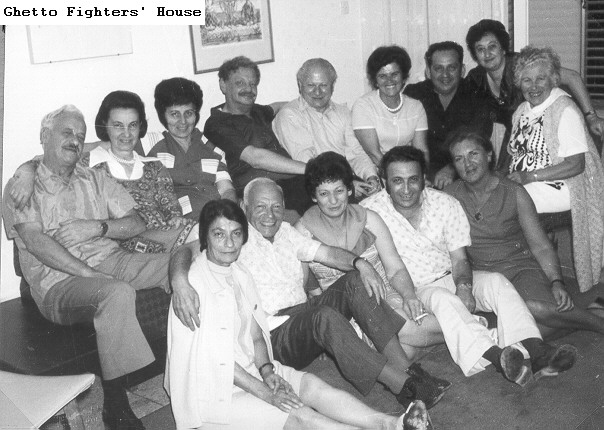
Was it worth fighting for life when all that remained of my loved ones were dust and ashes? Twenty-year-old Jakub Putermilch asked himself, staring at the moldy ceiling of the Warsaw bunker where he had survived "liberation." Behind him lay the hell of the ghetto, forest partisans, two Warsaw uprisings, and months of vegetating in ruins.
It was almost 2:00 a.m. on April 29, 1943. Suddenly, the bell rang in the gatehouse of the tenement building at 27 Ogrodowa Street. The caretaker, startled from his sleep, leaped from his bed. He was convinced that only Germans could be knocking on the gate at that hour. When he finally opened the building's doors a few moments later, he did indeed see men with weapons. However, these were not occupiers, but two pathetic-looking youths. They stood in puddles of stinking, brown slime that clung to their clothes. One of them introduced himself.
"My name is Dawid Nowodworski. There are several dozen people here with me from the Jewish Combat Organization. We have to hide. We know you can help us," he said emphatically.
Without hesitation, the caretaker replied that the only hiding place he could offer them was the attic on the fifth floor. He showed them the stairwell to use. Moments later, more sewage-smeared figures began to crawl out of a sewer hatch about 20 meters from the gate. The Jews crawled into the building itself, fearing they might be spotted by the German guards at the Żelazna Street station. They then climbed the creaking stairs to the den itself. The entire operation, which involved moving over 30 people from the sewer to the attic, was completed in about half an hour.
The next 24 hours dragged on endlessly for the ghetto escapees. They placed all their hope for rescue in the resourcefulness of "Antek" Cukierman, a ŻOB leader residing on the "Aryan" side. Through a caretaker, they passed on a message to his last clandestine address, but they had no idea if it was still valid.
Jakub Putermilch, then 18, a fighter, recalled the hours in the attic as his worst nightmare: "Our clothes stank. We were afraid the stench would betray our hiding place. […] Our clothes stuck to our bodies, and we shivered with cold. […] We were nervous and helpless. We knew that if someone discovered us, we would have nowhere to run. […] The chances of surviving there safely another night were zero. Toward evening, we heard the echoes of children's voices from the stairwell. They were saying 'Jews, Jews.'"
The Boy from Nowolipki
Putermilch grew up three blocks north of this temporary hideout, in a tenement house at 62 Nowolipki Street. He came from a traditional Jewish family, typical of Warsaw's Nalewka district. During the interwar period, his father owned a potato flour factory and also traded groceries and cigarettes. His mother, meanwhile, took care of the house and their four children. Jakub was born in 1924. He had an older sister, Hagit, and two younger brothers.
The boy's entire education took place in the building at Nowolipki 68. Both schools he attended were located there – a government Polish elementary school and a school run by the Tarbut organization , where instruction was in Hebrew. At the same time, inspired by his father and following the example of his older sister, he joined the Zionist Scouts Hashomer Hatzair . However, before he finally, as he had dreamed, became a pioneer in Eretz Yisrael, the hecatomb of World War II arrived. Jacob was the only survivor of his six-member family.
Leszno Fortress 76
From the beginning of the German occupation, Jakub Putermilch was active in the Jewish resistance movement, along with his sister and her fiancé, Abraham Zandman . Their cell was headed by Szmul Brasław , a publicist involved in underground publishing in the ghetto, among other activities, and a close associate of Mordechai Anielewicz and the Oneg Shabbat organization . According to Putermilch, as early as 1941, he was organizing his men on Fridays, which would later form the basis of anti-German self-defense. It's no surprise, then, that in July 1942, Brasław found himself on the first staff of the Jewish Combat Organization (ŻOB). It was from him that Jakub and his friends received their first pistol. Unfortunately, he was shot by the Germans just over a month later.
Half of the Putermilch family also did not survive the Grossaktion in the ghetto. In August, Jakub's mother and two younger brothers, with the help of a friend who was a navy blue policeman, left for Mrozy. They hoped they would be safer there than in Warsaw, where deportations "to the East" were reaching their peak. However, the ghetto there was also liquidated in September 1942. All three perished.
Jakub, his sister, and his father managed to survive the deportations by hiding in basements. In the following months, the boy worked in Hellman's shop (at the intersection of Nowolipki and Smocza Streets) and, above all, engaged in ŻOB activities. He learned to handle weapons, prepared Molotov cocktails, and broke passages through the attics of tenement buildings (which proved crucial during the uprising). He also participated in expropriation operations (including attacking one of the gambling houses in the ghetto) and arson attacks on German warehouses. His sister, Hagit , and her fiancé were also involved in the resistance. In mid-January 1943, Zandman poured acid on a Jewish policeman (Jakub?) Katz . A few weeks later, the couple participated in the liquidation of a certain Hirshl , the Jewish manager of Hellman's shop, in the gateway of a tenement building at 8 Smocza Street.
A few weeks before the uprising, Putermilch was assigned to a new unit quartered in a house at Leszno 76. The ten-person group preparing defensive positions there was commanded by Jakub Fajgenblat , a Gordonia activist . Of this entire group, only our hero and his colleague Aron Chmielnicki survived the war.
When the "ŻOB" (ZOB) units from Leszno launched their attack on the Germans on that fateful day of April 19, 1943, each unit member carried two grenades, a pistol, and several rounds of ammunition, not to mention a sizable supply of gasoline bottles. Putermilch and his companions spent the first two days of fighting engaged in low-intensity gunfights in doorways and courtyards within their area. They achieved greater success on the afternoon of Wednesday, April 21, when, together with two other ŻOB units, they attacked the Germans from the windows of houses at Nowolipie 65/67. Putermilch described these moments years later in his memoirs, "In Fire and Snow":
"This time the Germans were slowly driving in trucks. They were alert – looking in all directions. When the first car reached our positions, we pelted it with Molotov cocktails and grenades. We heard explosions, saw flames shooting out of the hit trucks. We heard the howls of Germans in burning uniforms, fleeing from the burning vehicles. They ran helplessly through the streets, trying to find shelter from the successive grenades and shells. These were moments of euphoria that I will remember for the rest of my life. Burning, helpless Germans. Just yesterday, they were the cruel masters of the ghetto. That moment gave me the strength to continue fighting."
However, further successes of this scale did not materialize. The insurgents' situation became increasingly dire. The Germans struck accurately and by surprise, discovering further bunkers and hideouts. Meanwhile, they had no means of defending themselves. Already on Friday, April 23, Eliezer Geller , commander of the ŻOB sector in the area of the Többens and Schulz workshops , ordered the fighters to fire only in self-defense, as their ammunition supplies were depleted. Furthermore, food was also running low.
Hunted, exhausted by combat and starvation, the desperate "ŻOB" members decided to retreat from the ghetto to the "Aryan" side. On the evening of April 28, a group of between 30 and 40 people entered the sewers from the basement of a house at Leszno 56. The fighters didn't hesitate for long. Their only option was to escape to Ogrodowa Street. There, in the tenement house at number 27, lived a caretaker, a trusted contact of ŻOB activist Stefan Grajek.
The man didn't disappoint his Jewish friends. Under the circumstances described at the beginning, on the morning of April 29th, the entire group—including Jakub and Hagit Putermilch—managed to find shelter in an attic on Ogrodowa Street. Unfortunately, their father remained in the ghetto. They never saw him again.
Forests and the 1944 Uprising
The nervous wait of the Jewish fighters in the Wola attic ended before dawn on April 30th. The caretaker and Cukierman's contacts succeeded. Their "savior" was Władysław Gaik, codename "Krzaczek ," an activist in the communist People's Guard . He transported almost the entire group of insurgents by truck to a safer location, a forest near Łomianki. A few days later, on May 10th, he brought more fighters from the ghetto to the same location, saved thanks to the efforts of "Kazik" Ratajzer.
On May 22nd, "Krzaczek" transported about 60 fighters to a forest near Wyszków . They were incorporated into the ranks of communist partisans. Putermilch's memoirs from this period contain no tales of daring actions. The Jews, along with their Soviet, Polish, and Georgian colleagues, were primarily engaged in the struggle for survival. They built hidden camps, stole food from peasants, and tried to minimize losses during German raids.
It's no wonder, then, that subsequent ŻOB veterans, if they managed to survive in the forest, tried to get to Warsaw as quickly as possible. Jakub was one of the last to return to his hometown. He endured the forests of northeastern Mazovia for exactly a year. During that time, he found the love of his life. He became involved with Masza Glajtman , a comrade from the organization, a girl from Nalewki 47. Unfortunately, shortly thereafter, he lost the last surviving member of his immediate family. Hagit, along with Abraham Zandman, belonged to Merdek Growas's unit . In the spring of 1944, the group went on an operation near the village of Sadowne and disappeared without a trace. Putermilch believed his entire life that they had been murdered by members of the Home Army. However , Dariusz Libionka , in his book "Prowincja noc. Życie i Zagłada Żydów w dystrykcie warszawskim," claims that they were most likely killed by bandits led by Norbert Gostomski, codename "Glastomski." "Lame" , operating under the banner of the "Sword and Plough" organization.
At the end of May 1944, Putermilch returned to Warsaw. In a hiding place in the attic of the house at Żelazna 64, he rejoined his beloved Masza, with whom he shared all the hardships and dangers of the subsequent wartime months. During the Warsaw Uprising, the two wandered around the city center. Their longest stay was at Warecka 11, where they were quartered across from the elderly Bishop Stanisław Adamski . Jakub then temporarily supported the Home Army soldiers on the barricades.
After the uprising collapsed, Jakub and Masza remained in the ruins of Warsaw. Initially, they hid with 32 others in a bunker on Śliska Street. They were lucky, because just before the Germans discovered the bunker, they moved to another hideout, at Sienna 38. There, they managed to survive until the Soviets arrived. So traumatized and cautious were they that they only emerged from hiding five days after the "liberation" – on January 22, 1945.
New life
After the war, Masha and Jakub Putermilch settled in Israel, specifically in Tel Aviv. They had two daughters, Rachel and Fanny . Jakub died in 1984, and his wife in 2007.
Putermilch's war memoirs, published in Hebrew in 1981 and recently in English, are surprisingly rarely cited in Polish histories of the Jewish Combat Organization. They contain numerous details, not only about the underground resistance in the ghetto but also about the activities of Jewish partisans in the Wyszków forests. This is certainly a work that should be published with a critical Polish translation.
Wojciech Rodak
Bibliography:
- A. Grupińska – "In a Circle. Conversations with Jewish Soldiers", Warsaw 1991
- J. Putermilch – "In Fire and Snow. Memoirs of Ghetto Fighter", 2019
- I. Cukierman – "Excess of Memory. Those Seven Years. Memories 1939-1946", Warsaw 2020
- ed. B. Engelking – "Province of Night. The Life and Extermination of Jews in the Warsaw District", Warsaw 2007
- B. Engelking, J. Leociak – "The Warsaw Ghetto. A Guide to a Non-Existent City", Warsaw 2013
- K. Person – "Policemen. The Image of the Jewish Order Service in the Warsaw Ghetto", Warsaw 2018