We are sharing a column by Dr. Martyna Grądzka-Rejak, head of the Scientific and Research Department of the Warsaw Ghetto Museum, published in the Plus Minus magazine – the weekend edition of Rzeczpospolita – on the occasion of the 80th anniversary of the closing of the Warsaw Ghetto borders.
November 17 2020
During World War II, nearly 400 ghettos operated for varying periods in the General Government (GG) and Bezirk Bialystok, and over 600 throughout occupied Poland. Most of them were established by the Germans in 1940–1941. Some operated for months, while others were established just before the deportation of the Jewish population to extermination camps. The Germans attempted to separate the ghettos from the rest of the population, but brick walls were erected only in a few cities.
Medieval inspirations
Separate Jewish quarters and their specific markings were not a concept created by the German Nazis. Such solutions were already known in the Middle Ages. After the Fourth Lateran Council in 1215, Jews and Muslims were required to wear clothing that distinguished them from Christians. The term "ghetto" itself derives from the designated Jewish quarter established in Venice in 1516. This word referred to a foundry or steelworks and was established in the part of the city adjacent to the foundry. The roots of the name are also believed to be in the Italian word "borghetto," meaning a town or small district. In Rome, a designated Jewish quarter was created, and the process of creating it resembled that replicated centuries later by the Germans. Those who left this area were ordered to mark their clothing with a yellow circle. The Roman ghetto was intended to separate Christians from the "unclean body of the Jew" and its "defilement of touch." The same sanitary-epidemiological motive also became the Germans' argument justifying the need to create closed districts for Jews.
Ghettos were intended to concentrate Jews in one location, isolate them from the "Aryan" population, and utilize them for labor in the Third Reich's economy. The creation of so-called Jewish residential districts, alongside German-issued legal acts interfering with personal freedoms and regulating property, economic, and other matters, was the first step towards their physical extermination. In October 1939, the first ghetto was established in Piotrków Trybunalski. The largest and most populous ghetto, in turn, was established in Warsaw. Separate sections of cities for the Jewish population were also designated in the summer of 1942, during Operation Reinhardt, the goal of which was to exterminate Jews in the General Government and Bezirk Białystok. These were established to gather them in one place before execution or deportation to a death camp. However, ghettos were not established everywhere, and Jews sometimes lived in their homes until deportation.
"Walled up" in the ghettos
Confinement contributed to feelings of loneliness, abandonment, and even isolation from the world. In most towns, the ghettos were demarcated by wooden fences, barbed wire fences, or specific streets, further reinforced by police stations of the so-called "Blue" and Jewish police, as well as German police officers. Brick walls were erected in a few towns, including those in Warsaw, Krakow, and Nowy Sącz. In June 1941, the governor of the Lublin district, Ernst Zörner, issued a decree that the ghetto in Lublin's Podzamcze district be enclosed by a wall. However, these recommendations were not implemented. Survivor accounts mention a wall around part of the ghetto in Miechów. Fragments of the wall around the ghetto in Krosno are also mentioned. It can be assumed that the Germans, when creating ghettos in these two towns, used existing brick structures and did not build new ones for this purpose. A fragment of the brick wall of the demolished synagogue, next to a wooden fence, also separated the ghetto in Łowicz.
Regardless of whether the ghetto was separated by a fence or other physical barrier, leaving its premises was only possible at designated locations, upon presentation of special passes. Attempts to illegally cross its borders carried consequences. German law regulated these matters in detail. The so-called Third Ordinance on Restrictions on Residence in the General Government, issued by Hans Frank on October 15, 1941, was crucial. It not only upheld the earlier order to isolate Jews but also stipulated that "Jews who leave their designated district without authorization are subject to the death penalty. The same penalty applies to persons who knowingly provide such Jews with a hiding place." This law significantly influenced those considering whether to seek refuge on the so-called Aryan side, and also influenced Polish-Jewish relations and the decision to aid escapees from the ghettos.
Warsaw, Krakow, Nowy Sącz
The decision to build walls around the Jewish district of Warsaw was made in March 1940. The Germans wanted to tightly seal off the "area threatened by epidemics," as this part of the city was referred to. On March 18, the chairman of the Warsaw Judenrat, Adam Czerniaków, wrote in his diary: "a demand that the Community wire up the 'ghetto,' drive in poles, etc., and then supervise it." Two weeks later, the Jewish Council received official instructions to build the wall. Chairman Czerniaków noted on April 1: "We started digging holes for the walls this morning at 7:00 AM." In his book "Bread Thrown to the Dead," Bogdan Wojdowski wrote about the subsequent stages of construction: "Here – at the intersection of Żelazna and Krochmalna Streets – the boundary wall rose right under the windows of the tenement houses. From dawn until dusk, the cries of the bricklayers echoed, and the roar of water from the fire hydrant, open alongside, rose in the road. In two shifts, wheelbarrows squealed briskly, and the wet clatter of trowels and mortar being thrown onto the bricks echoed. They built the wall. It reached the bricklayers' knees, then their shoulders. They measured, laid the bricks, and continued on. When it was twice as tall as a man, they reinforced the top of the wall with crushed bottle glass, thickly thrown onto the damp cement." By mid-June 1940, the construction was completed. The sixteen-kilometer-long wall, approximately 3 meters high, was reinforced with barbed wire. It was not continuous; in places, the brick structure was replaced by a wooden fence. The boundaries were also marked by tenement buildings, whose doors and windows on the so-called Aryan side were bricked up. As Chaim Kapłan wrote, "These walls blocked off the streets that had been the busiest until then," which necessitated significant changes in traffic organization. On November 16, 1940, the walls around the Warsaw ghetto were closed, and its inhabitants were isolated from the rest of the city.
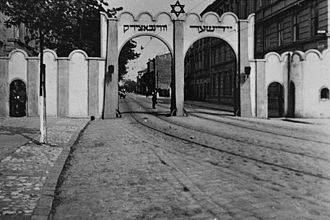
When viewing photographs of the Krakow Ghetto, it's impossible to miss the impressive entrance gate leading from Podgórski Market Square. It bore a Star of David and the Yiddish inscription "Yidiszer Woinbecirk." The gate and its connecting wall were topped with a semicircle, resembling a matzevah—a Jewish tombstone. The Krakow Ghetto was established by a decision issued on March 3, 1941. It was located in Podgórze, a neglected and poorly modernized part of the city. Initially, the area was fenced with barbed wire and guarded by German, Polish, and Jewish services. In April, during the Passover holiday, workers from a Polish construction company hired by the German Arbeitsamt began building a wall around the ghetto. Pole Tadeusz Pankiewicz, whose pharmacy was located within the ghetto, recalled: "Dozens of bricklayers and carpenters were building the wall day and night, grating the windows in the tenement houses overlooking the 'Aryan' district, driving in piles, building gates. People watched in horror as the walls grew, which strangely changed the face of the ghetto." Teenage Renia Knoll wrote in her diary: "It's so sad here! Wherever you look, you see black, gloomy walls rising towards the sky, with tombstones on top." The ghetto covered approximately 20 hectares. The area that had previously housed around 3 people would now house over 10, and over time, almost twice that number. Józef Bau, a witness to these events, described the impression the wall made on him this way: "like a noose twisted from bricks seasoned with hatred, it choked the houses populated by Jews in an unbelievable cramped space." The wall was not continuous; it was built, for example, on Lwowska Street, Rękawka Street, and near Podgórski Market Square, but sections remained, surrounded by barbed wire, later converted into a fence. In places, as in Warsaw, the boundary was marked by the walls of tenement houses, where windows facing the so-called Aryan side had been boarded up, wired up, or bricked up.
A wall, though much shorter, was also built in Nowy Sącz. The local ghetto, or rather two sections: one designated for working people, the other – located in the city center – for those who didn't work, was established on August 12, 1940. In the summer of 1941, construction began to separate the ghetto area for those who didn't work from the so-called Aryan side. A three-meter-high wall divided the two parts of the city. The creation of a closed ghetto in the very center of Nowy Sącz and the erection of the walls changed the city's topography, disrupting existing communication routes and causing operational disruptions.
Sections of the ghetto walls were demolished after the deportations, particularly those sections that caused difficulties in moving around the cities. In Warsaw and Krakow, this was partially done during the reduction of the Jewish quarter; the remaining sections were demolished after the end of the war. A similar process occurred in Nowy Sącz. The section that survived into the postwar period was demolished due to the need for building materials in the rebuilding city. Only a few fragments of the walls remain in these locations. They are both silent witnesses to the tragic events that unfolded within their boundaries and a warning against the consequences of dividing people into better and worse, or redundant, individuals who, for various reasons, should be isolated.
Dr. Martyna Grądzka-Rejak
The author is a historian, head of the Scientific and Research Department at the Warsaw Ghetto Museum; an employee of the BBH IPN.
Photo: APW