

Tzivia Lubetkin (1914–1978)
Leader of the Jewish Combat Organization, a heroine of the Warsaw Ghetto Uprising and the Warsaw Uprising. Her code name was “Celina.”
“For a few moments, we were happy. We saw with our own eyes the Germans fleeing in panic. The soldiers who had conquered the world were fleeing from Jewish boys armed only with a revolver or a grenade,” Tzivia Lubetkin recalled after the war.
She was born on November 9, 1914, in Byten near Slonim, in what is now Belarus, into a traditional Jewish family. She was the daughter of Jaakov-Isaac and Chaya (née Zilberman), who ran a store together. She had five sisters: Shifra, Meita, Golda, Bunia, and Luba, and a brother, Shlomo.
She attended a Polish state school and also took private Hebrew lessons. She was fluent in both Yiddish and Polish.
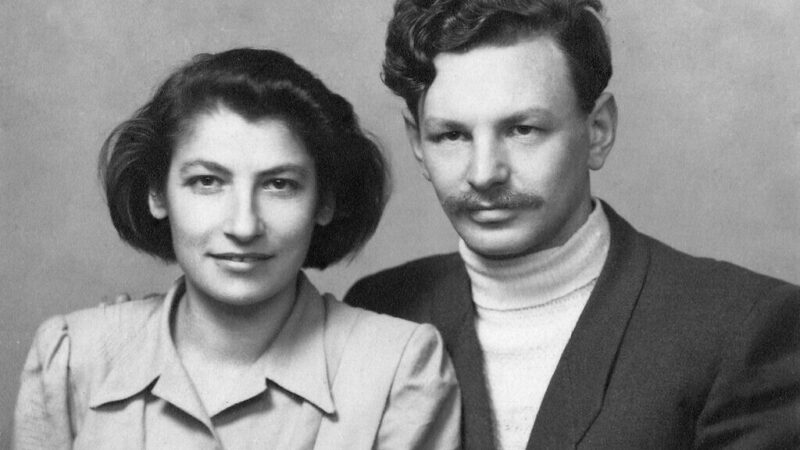
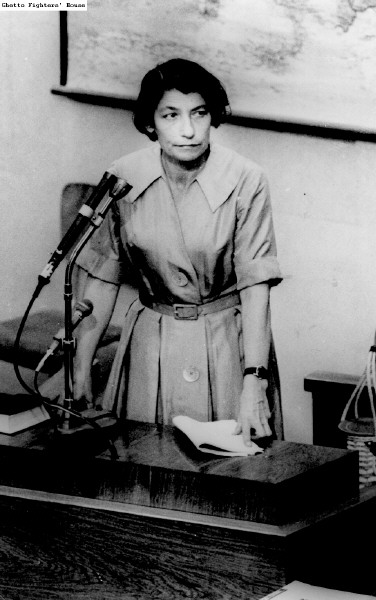
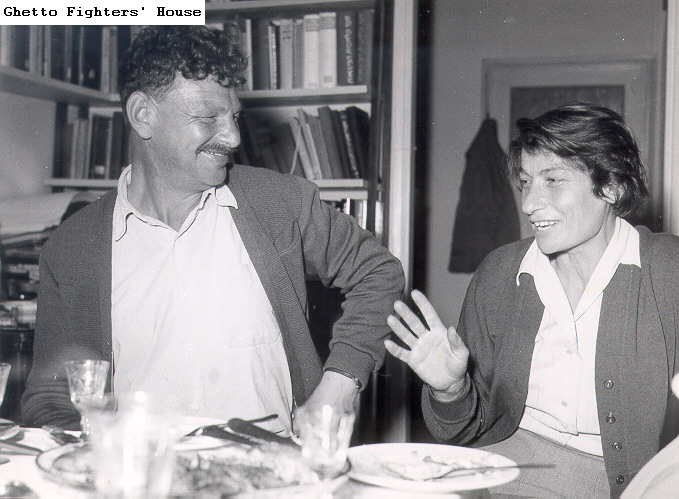
2. Cywia testifying at the Eichmann trial in 1961.
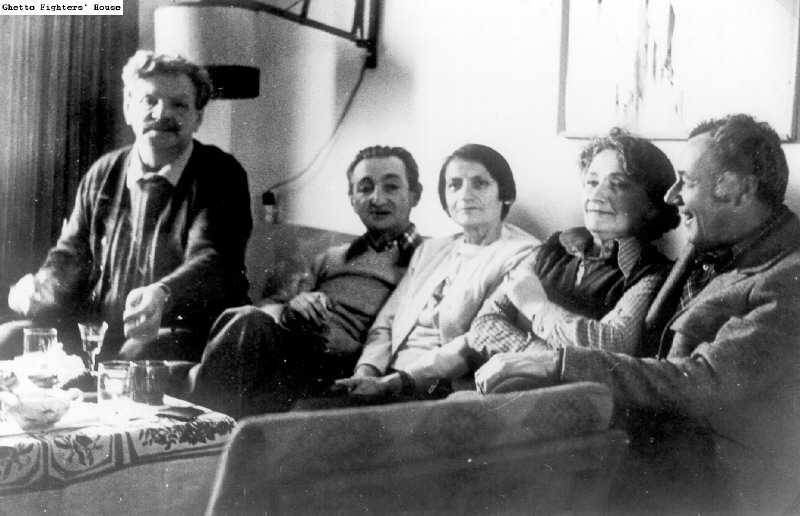
3. Cywia Lubetkin with her friends, in 1978, three months before her death. From the left: Icchak Cukierman, Marek Edelman, Cywia Lubetkin, Luba Gewisser, Symcha Rotem “Kazik.”
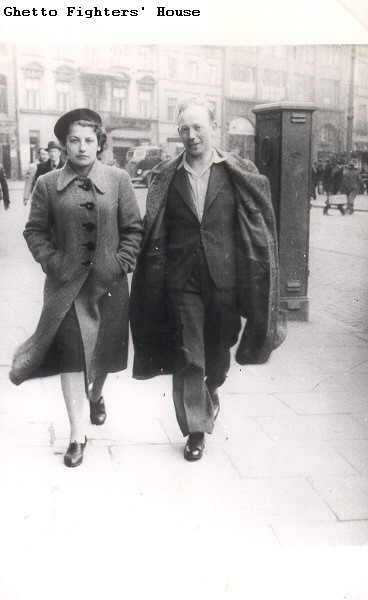
4. Lubetkin and Symcha Rotem Rathajzer “Kazik” on the streets of Warsaw.
5. Cywia and Icchak in Israel in the 1950s.
From a young age, she was active in Zionist-socialist youth organizations. Her commitment and the energy with which she worked to organize courses designed to prepare Jewish youth for emigration to Palestine were recognized by the leadership of “Dror” (Hebrew for “Freedom”). In the second half of the 1930s, she joined the leadership of this organization. Years later, her enthusiasm was recalled by Yitzhak Zuckerman, alias Antek—who was also active in “Dror” at the time:
“I remember that as early as 1936… a meeting of comrades was taking place there. (…) The kibbutz in Kielce had hundreds of members at the time. (…) There was a table in the middle, and next to the table stood a young girl, speaking. And after every sentence, she would bang her hand on the table. I took notice of her. Then I saw her again in 1940—what strength!”
In 1939, she was a delegate to the 21st World Zionist Congress in Geneva. She returned to Warsaw shortly before the outbreak of World War II. After the German invasion of Poland, she left for the east—first to Kowel, then to Lviv, where, together with other Dror leaders, she engaged in underground activities. At the turn of 1939 and 1940, despite the possibility of traveling through Romania to Palestine, she returned to the General Government to continue her work with the organization there.
She settled at 34 Dzielna Street in Warsaw, where Dror’s leadership center in Poland was located. Even before the ghetto was established, she was involved, among other things, in raising funds for Dror. As Zuckerman recalled, “she was always on the move through the corridors of various institutions, attending meetings and gatherings. She served as Dror’s representative in various institutions. She was well-known.” It was also during this period that Lubetkin and Zuckerman became a couple.
After the Warsaw Ghetto was closed, Tzyvia actively participated in organizing resistance structures. The collective established by Dror at 34 Dzielna Street, sometimes referred to by its members as a kibbutz, was—in Lubetkin’s words—“like a separate island—a stark contrast
to Jewish Warsaw, which was in turmoil and helpless. The kibbutz on Dzielna Street was a home not only for comrades (…) but also for people far removed from our movement.” Jewish activists gathered there for lectures and discussions intended to continue their pre-war educational and upbringing work. Over time, an informal middle school even came into being, made possible by the support of comrades abroad:
“For many long months, the middle school was sustained by packages sent to us by comrades from Vilnius. We received cold cuts, butter, and other delicacies that were otherwise unavailable to us. We sold these ‘luxury items’ and used the money to buy bread for the children, the teachers, and their families. For months on end, we had no funds to pay the teachers’ salaries,” she wrote after the war.
At the turn of 1941 and 1942, information reached the leadership of Dror and other organizations in the ghetto about the mass murders of Jews, including in Vilnius, and later also at the extermination camp in Chełmno nad Nerem. This made some activists realize the scale of the Holocaust planned by the Germans. Younger members began to push for the organization of self-defense, while older members remained cautious.
The first major initiative was an agreement among left-wing Jewish organizations—the PPR, Poale Zion Left, Hashomer Hatzair, and Dror—which formed the Anti-Fascist Bloc. This organization attempted to obtain weapons, published an underground press, and resisted deportations. Lubetkin was one of the initiators and a member of its leadership.
After the Germans launched the so-called “Great Deportation Campaign” to the Treblinka extermination camp on July 22, 1942, she participated in the founding meeting of the Jewish Combat Organization (ZOB) on July 28. She became a member of the first ZOB command and was also a member of the Jewish National Committee and the Jewish Coordinating Committee.
She took part in the ZOB’s first armed operation in January 1943. The Dror unit, which included Cukierman and Lubetkin, lay in wait for the Germans in a tenement house at 58 Zamenhofa Street. The Germans entering the apartment were surprised by accurate shots from a pistol—Zacharie Artsztajn managed to kill two of them, and the rest of the patrol began to retreat, firing chaotically at the Jews. The fighting moved to the stairwell, where the Jewish fighters threw several grenades after the Germans.
“We all took part in the clash, each with whatever we could—hand grenades, revolvers, iron bars, bottles of concentrated sulfuric acid. Zacharie and Henoch (Gutman) collected the weapons of the dead and wounded Germans. The rest chased the fleeing soldiers. For a few moments, we were happy. We saw with our own eyes the Germans fleeing in panic. Soldiers who had conquered the world were fleeing from Jewish boys armed only with a revolver or a grenade,” Lubetkin described the action in her memoirs.
The January operation significantly influenced the mood in the ghetto—support for armed resistance grew, and the Polish underground Home Army’s attitude toward the Jewish
Combat Organization (ŻOB) changed, which resulted in larger weapons shipments. Intensive preparations for the uprising began.
“The task of organizing the Warsaw Uprising was entrusted to me, Yitzhak Zuckerman, Mordechaj Anielewicz, Miriam Hajnsdorf, and Izrael Kanał,” she wrote. Despite this, neither Lubetkin nor Hajnsdorf formally held any important positions in the Jewish Combat Organization (ŻOB) at the time. All leadership positions were held by men, which was a clear departure from the norms in the youth organizations from which the ŻOB leadership had emerged. From the accounts of underground members, a clear picture emerges of women such as Lubetkin and Altman, who enjoyed great respect and informal authority among their comrades-in-arms, but did not formally lead any units. Tzivia’s own role is evidenced by the fact that she was the one tasked with speaking to the head of the Supply Department, Abraham Gepner, about how much funding the ŻOB could receive from him.
On April 19, 1943, the Germans began the final liquidation of the ghetto. An uprising broke out. In theory, Lubetkin served as a liaison—she moved between bunkers and maintained communication between the command, and the fighting units. In practice, she often made important decisions on her own, such as when she chose which shelters to direct the insurgents to from the destroyed hideouts. One of the stories she told after the war clearly illustrates how important her position was in the ŻOB. When, after several days of fighting, she reached one of the combat groups, its members organized a small celebration to welcome her, preparing for Tzivia—an unheard-of thing under the conditions of the uprising—a refreshing bath and a dinner of roast chicken.
A few days later, she reached the bunker at 18 Miła Street, where the ZOB command was located. During this period, the morale of the insurgents began to deteriorate. Contact with the Polish underground outside the walls had ceased, and the Germans had begun the systematic destruction of successive blocks of the ghetto. After the war, Lubetkin spoke of the thoughts that accompanied her at the time: “We were haunted by a question to which there was no answer: What now? Helplessness throughout the ghetto. There is no way out. […] All our plans had collapsed.” During this period, Anielewicz decided to seek a way to escape from the burning ghetto. To this end, he sent several groups through the sewers to determine where they led and whether they were passable. The most promising route turned out to be the exit through the bunker at 22 Franciszkańska Street, from which a passage to the sewers had been cut. On the evening of May 7, Lubetkin and Chaim Frymer were sent from Miła to this hideout, where Marek Edelman was also staying at the time, to plan the evacuation through the sewers. As they finished their conversation, dawn was breaking. Lubetkin wanted to return to Miła Street, but—as Pnina Grynszpan-Frymer recounted years later:
“Then Chaim (Frymer) said to Tzivia: ‘You are my commander, but this time I will not obey your order.’ Cywia agreed; it was too dangerous to walk around the ghetto during the day, so they stayed with us in the bunker. It was on that very day that the bunker on Miła Street was discovered. One could say that Chaim saved Tzivia’s life. After all, if they had returned to Miła Street, they would have perished along with Mordechaj and the others.”
Lubetkin, Frymer, and Edelman set out for Miła Street that evening, where they were met with the horrifying sight of several ZOB fighters who had managed to survive the German attack on the bunker on Miła Street—covered in blood, gasping for breath, lying unconscious on the ground. From their accounts, it appeared that civilians had emerged from the shelter at the Germans’ command, while about a hundred fighters remained underground. Most of them died by suicide or were poisoned by gas from smoke bombs thrown in by the Germans.
On the night of May 8–9, Lubetkin and Edelman ordered the surviving fighters to descend into the sewer and follow the guides toward the manhole on Prosta Street. After more than a day of walking and waiting for a suitable opportunity, around noon on May 10, the insurgents emerged from the sewer and jumped onto the flatbed of a truck waiting for them. However, not everyone managed to fit, and the evacuation of the remaining fighters could not be organized. For the rest of her life, Tzivia was haunted by a sense of guilt over leaving the insurgents in the sewer.
After escaping the ghetto, she joined a group of surviving fighters in the forests near Łomianki. A temporary ZOB command was established there, of which Tzivia became a member. They were soon joined by Zuckerman, who had been outside the ghetto since April 13 as the ZOB representative in that part of Warsaw. After Anielewicz’s death, he assumed the role of the organization’s commander.
Due to the danger, the group had to leave the forests and seek shelter in Warsaw. Zuckerman focused his efforts on securing the promised support from the Home Army (AK), but no help arrived. They managed to secure hideouts in Warsaw for a few fighters; the rest were forced to accept the communist People’s Army’s proposal to transfer the ŻOB members to partisan camps in the forests along the Bug River.
Tzivia left the forest on May 19 and ended up in an apartment at 4 Komitetowa Street, where she hid together with Antek, Edelman, and Symcha Rotem -Kazik. For a year after the fall of the ghetto uprising until the outbreak of the Warsaw Uprising, they were forced to change hiding places many times. Tzivia, who in the ghetto—even during the uprising—had moved freely at night on the so-called “Aryan side,” could not go out onto the street because she “looked too Jewish.” As a result, she fell into depression. She was haunted by the destruction of the ghetto, the loss of close friends, and feelings of guilt and remorse for abandoning the fighters on Miła Street and later in the sewers. Her husband had a “better appearance” and often went out, which intensified Tzivia’s suffering as she worried about him.
Despite this, Lubetkin participated in decision-making and often had the final say regarding operations carried out on the so-called “Aryan side” by Antek and Kazik. Together, they provided aid to Jews living there, organized hiding places, countered blackmailers, and supported resistance groups in other ghettos and camps.
After the outbreak of the Warsaw Uprising on August 1, 1944, the surviving leadership of the Jewish Combat Organization (ZOB) decided to take part in it and fight alongside the Poles.
“Toward evening, the three of us—Icchak, Tzivia, and I—sat down (…) and decided to meet with the leaders of Poale Zion-Left so that the surviving members of the movement could jointly join (…) the National Council (…)” Tuwie Borzykowski recounted after the war.
The ZOB command made efforts to join the Home Army as a Jewish insurgent unit. “We were received indifferently, coldly,” Tzivia wrote about the meeting with the Home Army command. The Jews, however, were welcomed with open arms by the People’s Army, which allowed for the formation of a united insurgent unit. “We joined the uprising to fight, not to pretend we were fighters,” said Tzivia, in response to the People’s Army’s suggestion that Jews should not risk their lives and should fight only in the vicinity of headquarters.
The Jewish unit, numbering 22 people, was assigned a position at the barricade on Mostowa Street, at the exit from the Vistula escarpment. At the end of August, when the situation of the insurgents fighting in the Old Town became critical, the uprising command decided to evacuate the fighters. This time, Lubetkin, Zuckermann, and Edelman made their way through the sewers to Żoliborz, where they reached the home of Basia and Adolf Berman. Basia Temkin-Berman described in her “Diary…” how, on August 30, 1944, three strangers suddenly appeared at her door:
“At the head, barefoot, ragged, with a bandaged, disheveled head, Antek (Zuckerman) strides along in a German protective cape; behind him, a petite girl with her forehead and neck covered in bandages and dressings—I assume it is Tzivia (Lubetkin); then a dark-skinned boy in a military cap (…) who turns out to be Marek Edelman.”
The Bermans fed, clothed, and hosted the newcomers. A month later, Basia Berman noted:
“In the evening, around seven, Antek would come over with Celina (Lubetkin); we’d drink coffee together and chat until ten. We became very close to them. They were truly extraordinary people. I grew very fond of Tzivia, who turned out to be much wiser than I had imagined. She would tell stories for hours that sounded like tales from One Thousand and One Nights.”
After the uprising’s capitulation, Lubetkin went into hiding along with the remaining surviving ZOB fighters in the ruins of Warsaw, in a basement beneath an apartment at 6 Promyka Street. Three elderly Jewish women, hiding under so-called Aryan names, were staying in that apartment. Tzivia, Antek, Marek Edelman, Tuwie Borzykowski, and several others spent six weeks in that basement. Until November 15, when the Germans began demolishing the building. Death once again stared into the eyes of the exhausted handful of fighters. At the last moment, a rescue delegation arrived, led by Dr. Stanisław Śwital — the head of the Red Cross Hospital in Boernerów near Warsaw.
The two weakest survivors were placed on a stretcher, which was carried in turns by the rescuers and the remaining men from the group. To conceal Edelman’s typically Jewish appearance, his head was bandaged. Tzivia and Tosia Goliborska were wearing peasant clothes, and each carried a sack full of old belongings on her back. After a few hours’ journey through the ruins of the city, marked by various adventures, everyone safely reached the hospital, where they were washed and underwent medical examinations. It was only after the war that Dr. Śwital learned that the people he had saved were the surviving members of the command and fighters of the ZOB.
Tzivia and Antek then went into hiding in an apartment in Włochy, near Grodzisk. There, Lubetkin discovered she was pregnant. The couple made the emotionally difficult decision to terminate the pregnancy, as their precarious situation—with their lives constantly in danger—did not allow for the child to be born. Antek was deeply affected by this, even many years after the war.
January 17, 1945, on the day the Red Army entered Warsaw, Tzivia and Antek went to the city square.
“In the afternoon, Soviet tanks appeared. People were kissing and hugging each other. We, the Jews, stood there sad and dejected,” Cywia recounted.
Shortly thereafter, she became involved in helping Holocaust survivors: she searched for the missing, established kibbutzim and training centers, and coordinated the emigration of Jews to Palestine.
Tzivia and Antek’s office served as both a social center and a hub for the emigration movement, where emissaries from Palestine also found their first home.
She herself waited another year for aliyah (emigration to Israel).
“Despite all these differing approaches, however, we were all aware of one thing: we could not rebuild our ruined lives in Poland,” she testified in 1946.
In 1946, she emigrated with her husband to Palestine. After the establishment of the State of Israel, she co-founded the Kibbutz Lochamei-ha-Geta’ot (Ghetto Fighters) and was the initiator of the Ghetto Fighters Museum. There she gave birth to two children: Shimon (1947) and Yael (1949).
In 1961, she testified at the trial of Adolf Eichmann.
She published her memoirs, in different newspapers, collected then in form of the book “In the Days of Destruction and Revolt” (1979).
She died in 1978 at the Lochamei-ha-Geta’ot kibbutz. Zuckerman died in 1981. Their kids and grandkids live in Israel.
Bibliography:
Cukierman I., Nadmiar Pamięci. Siedem owych lat, Warszawa 2023
Gutman I., Mered hanetsurim: Mordekhai Anilevits wemilhemet geto warsza, Jerozolima 2013.
Lubetkin C., Zagłada i Powstanie, Warszawa 1999
Lubetkin, C., Ahronim al hahoma, Ein Harod: 1946
Temkin-Berman B., Dziennik z Podziemia, Warszawa 2000
Grupińska A., Ciągle po Kole. Rozmowy z żołnierzami getta warszawskiego, Wołowiec 2013.
Cwika D., Dapei Edut – 96 Hawrei Mikubuc Lohamei Hagetaot, Tel Aviv 1984.
Gutterman B., Na Warcie – o Cywii Lubetkin po aryjskiej stronie Warszawy i w powstaniu warszawskim,”Zagłada Żydów. Studia i Materiały”, 8/2012, s. 271-288