
Guta Kawenoki (1919–1944)
Heroine of the Warsaw Ghetto Uprising, soldier in the Jewish Combat Organization
“Is it because I am a woman that I am not fit for the partisans? (…) Guta begged Eliezer to let her come with us, saying she wanted to fight.”
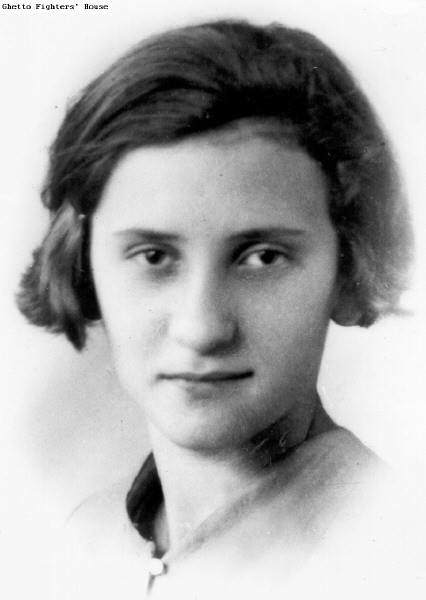
Guta Kawenoki, Fot. Ghetto Fighters' House.
She was born in 1919 in Lodz to a well-to-do family. Her mother was a pharmacist, while her father ran a textile factory. As a teenager, she became involved in the activities of Gordonia—an international socialist-Zionist youth organization founded in 1923 in Galicia.
Before the outbreak of World War II, she worked as a dental technician’s assistant. In September 1939, she was still living in Lodz. When the Germans divided the occupied Polish territories and established the quasi-state of the General Government (GG) from the central parts—Lodz found itself in the so-called territories incorporated into the Reich, where restrictive conditions prevailed and stricter laws were in force.
In 1940, Guta decided to move to Warsaw. After the Warsaw Ghetto was sealed off, she became involved in the Jewish resistance movement. When the Jewish Combat Organization (ZOB) was established on July 28, 1942, she took on the task of raising funds to purchase weapons for the movement. In the months leading up to the outbreak of the ghetto uprising, she joined the Gordonia combat group in the shed area, where another Gordonia member—Eliezer Geller—was in command.
She took part in ZOB operations targeting those who were enriching themselves by exploiting Jewish workers. The fighters kidnapped factory owners and their family members, demanding ransom, and used the funds obtained in this way to purchase weapons for the underground. Aron Karmi, a member of the combat group to which Kawenoki belonged, recalled after the war:
“Usually it ended amicably, but there were those who refused to pay. In that case, we had to take them to prison. In our area, Toebbens’ and Schultz’s workshops, I remember two prisons: Leszno 56 and Leszno 76.” The prisoners remained there until they agreed to pay the ransom. Karmi also described the daily life of the organization’s members:
“We lived in a commune. There were 12 of us. We slept in the attic and learned how to use weapons. (…) We lived like a family. We took money from people, sometimes half a million, but we didn’t have any money ourselves. We lived on black ersatz coffee and bread with marmalade; I didn’t see any meat back then (…). Money was sacred; it was for weapons.”
Yitzhak Zuckerman , deputy commander of the ZOB, described in his memoirs one of the operations in which Guta Kawenoki played a key role. The target was Marian Hendel, who was doing business with one of the German owners of the Toebbens and Schultz workshops.
The ZOB members knew that Hendel had substantial financial resources, so they sent him a letter demanding that he hand over the money. Hendel, however, ignored this warning.
The fighters then learned that he was trying to obtain a foreign passport and was in contact with a man named Gerwiński regarding this matter. They decided to use this information to their advantage. Zuckerman wrote:
“We chose a friendly and pretty girl, Gitta Kwonki from Gordonia. Using the information from Gerwiński, she got past the guards and reached Hendel. She told him: the matter you discussed with Gerwiński has been taken care of; you are to report to such-and-such a place in an hour. Hendel joyfully called his wife and said: ‘An occasion like this deserves a bottle of wine and some cake.’ He poured wine into glasses, they ate the cake, and then he went out after Gitta.”
Hendel was captured by the fighters and placed in custody. There he heard:
“No passports, no trips abroad. Hand over the money!”
On April 19, 1943, the Warsaw Ghetto was surrounded by the Germans, which marked the beginning of the uprising. Guta fought in a combat group led by Jacek Fajgenblat in the Toebbens workshop. Although the fighters began to run out of ammunition after a few days of fighting, no one considered leaving the ghetto. However, after ten days of fighting (April 28), the fighters received an order to go to the shelter at 56 Leszno Street and attempt to break through the ghetto walls—as Aron Karmi recalled.
On the way, they visited a field hospital located at 76 Leszno Street. Wounded fighters were being treated there. Eliezer Geller asked one of them—Meir Schwartz, who had been wounded in the arm—if he would be able to make the journey with the group. When he replied in the affirmative, he was allowed to join the unit.
Geller then turned to Kawenoki and instructed her to stay with the wounded, to which she reacted with a vehement protest:
“Is it because I am a woman that I am not fit for the partisan movement? (…) Guta begged Eliezer to let her come with us, saying she wanted to fight,” Karmi recounted after the war.
The commander did not change his mind. Then another female fighter—Lea Korn—volunteered to care for the wounded. A few days later, they all perished when the Germans set the building on fire.
On the night of April 28–29, Guta and about 40 others went down into the sewers. The group managed to reach a manhole at 27 Ogrodowa Street, where they waited for contact from Stefan Grajek. After the agreed signal, everyone left the sewer and hid in the attic of a nearby building. Three days later, a truck sent to pick them up transported them to the forest near Łomianki. There, Guta, along with other members of the ZOB, joined a partisan unit.
She fought in the forests around Wyszków and in the area of Czerwony Bór on the Narew River. When she fell ill in early 1944, she had to return to Warsaw. Together with Jakub Fajgenblat and Zygmunt Igła (from ZOB)—she went into hiding in an apartment at 6 Grzybowska Street. However, the hideout was exposed by an informant.
Wladka Meed wrote after the war:
“The Gestapo surrounded them, demanding that they surrender voluntarily. But not them! Zygmunt, along with Guta and Jakub, barricaded themselves in and then defended themselves fiercely, letting no one near them. All three were killed.”
There is also another version of these events. According to it, Kawenoki, Igła, and Fajgenblat were to visit the apartment of Home Army liaison Maria Cassiano to collect weapons for the Jewish resistance movement. The Gestapo, alerted by a member of the National Armed Forces, stormed the apartment. During the shootout, all of them were killed.
Posthumously, on April 19, 1948, Guta Kawenoki was awarded the Cross of Valor (Polish: Krzyż Walecznych) – a distinguished Polish military decoration to recognize soldiers for acts of valor and courage on the battlefield.
Bibliography:
Zuckerman Y., Surplus of Memory: Chronicle of the Warsaw Ghetto Uprising, Berkeley 1993
Meed V., On Both Sides of the Wall, Washington 1993
Grupińska A., Ciągle po Kole. Rozmowy z żołnierzami getta warszawskiego, Wołowiec 2013
Grynberg M., Księga Sprawiedliwych, Warszawa 1993.
https://collections.yadvashem.org/en/righteous/4015562 ((access 27.05.2026)
https://sztetl.org.pl/pl/miejscowosci/l/497-lodz/107-listy-nazwisk/84442-bojownicy-getta-warszawskiego-pochodzacy-z-lodzi (access 27.05.2026)