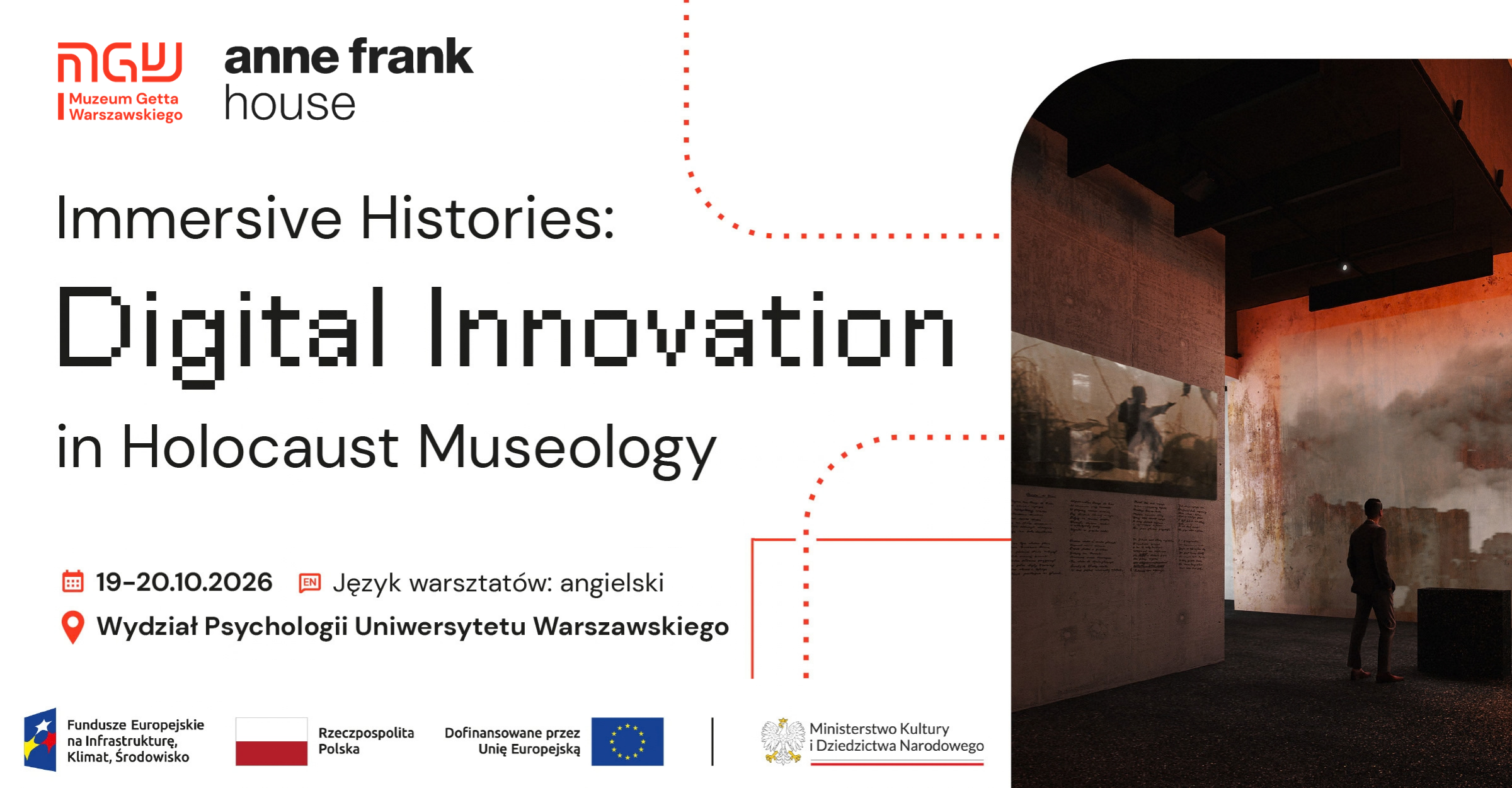
Seminar: Immersive Histories: Digital Innovation in Holocaust Museology

Digital technologies have become a permanent fixture in museums, paving the way for new developments for these institutions. The Warsaw Ghetto Museum, in conjunction with the Anne Frank House Museum in Amsterdam, is organizing a workshop on how digital technologies in museums help address the tragic experience of the Holocaust.

Seminar: Immersive Histories: Digital Innovation in Holocaust Museology
Immersive Histories: Digital Innovation in Holocaust Museology will take place in Warsaw on October 19–20. Nearly twenty participants from museums and institutions conducting digital projects on the history of the Holocaust in the Netherlands, Poland, Lithuania, Hungary, England, Serbia, Greece, and the USA will tackle the challenging topic of practical application of new technologies in building museum messaging and addressing the educational tasks conducted by these institutions.
 
A key topic discussed during the meeting will be the ethical boundaries of creating digital tools for working with knowledge about the history of the Holocaust and its representation. During the workshop, participants will have the opportunity to test existing tools and technologies used in various museums. A discussion will conclude the meeting, attempting to assess the impact of the digital revolution on Polish museums.
Attention: The event will be held in English.

Free registration required: LINK

Workshop program:


19 October 2026

9:00 AM – 11:00 PM
Panel I: Exhibition – Technology in Practice: Case Studies
chair: d
Sylwia Papier (Jagiellonian University)

  • Tomasz Michaldo (The Auschwitz-Birkenau State Museum), Virtual Tour of the Auschwitz-Birkenau Memorial
  • Gerrit Netten (Anne Frank House), Anne Frank HouseVR
  • Sarah Pitcairn (United States Holocaust Memorial Museum (USHMM)), The Tower of Faces AR


11:00 AM – 11:30 PM
Coffee Break


11:30 AM – 13:30 PM
Panel II: Education – Technology and Participatory Learning
chair:
Miško Stanišić (Terraforming)

  • Dagmara Chełstowska (Warsaw Ghetto Museum), Digital Educational Initiatives
  • Kamil Gut (Auschwitz Jewish Center Foundation (AJCF)), Auschwitz Jewish Center Foundation's Mobile App
  • Christina Beresniova (Vilna Gaon Museum of Jewish History), Interactive Learning Tools in Vilna Gaon Museum
  • Clare Lawlor (Imperial War Museum), Digital Holocaust Education and Digital Exhibition Elements: Educational Strategies


14:30 AM – 16:30 PM
Panel III: Ethics – Beyond the Limits: Good Practices
chair:
Dr. Martyna Grądzka-Rejak (Warsaw Ghetto Museum)

  • Barna Szász (Parallel Stories), If These Streets Could Talk AR: From Storytelling to Storyliving – Augmented Reality for Holocaust Memory
  • Dr. Joanne Popińska and Tom C. Hall (Infinite Frame Media),
    Reich of Ashes: Bearing Witness to Holocaust History through VR Documentary and Immersive Installation
  • Eirini Angeli (TWI Hellas), Echoes and Ethics: The Experiences of an International Team


20 October 2026

9:00 AM – 10:15 PM
Online presentation

  • Dr. Ben Pelling (Landecker Digital Memory Lab), Presentation on Digital Holocaust Memory Projects Database


10:15 AM – 10:30 PM
Coffee Break

10:30 AM – 12:00 PM
Round Table: Digital Transformation in Polish Historical Museums and Memorial Sites
Chair: Dr. Sylwia Papier (Jagiellonian University)

  • Tomasz Michaldo (The Auschwitz-Birkenau State Museum)
  • Dr. Kamil Karski (KL Plaszow Museum – Memorial Site)
  • Catherine Jankowski (POLIN Museum of the History of Polish Jews)
  • Dr. Emilia Rekosz-Cebula (The Cukerman's Gate Foundation)
  • Franciszek Bojańczyk (Warsaw Ghetto Museum)


12:00 AM – 13:00 PM
Digital Showcases


#EuropeanFunds

Implementation of the project "Renovation and expansion of the historic buildings of the former Bersohn and Bauman Children's Hospital at 60 Sienna Street/51 Śliska Street in Warsaw, along with their adaptation for exhibition and educational purposes, and the construction of a Media Library – part of the permanent exhibition of the Warsaw Ghetto Museum." The project is made possible thanks to funding from the European Funds for Infrastructure, Climate, Environment 2021-2027 (FEniKS) program. The amount of funding from the European Regional Development Fund is PLN 57,423,828.88. The total project value is PLN 323,879,688.83.

Graphic grants "European Funds for Infrastructure Climate, Environment, Republic of Poland, Co-financed by the European Union, Ministry of Culture and National Heritage"