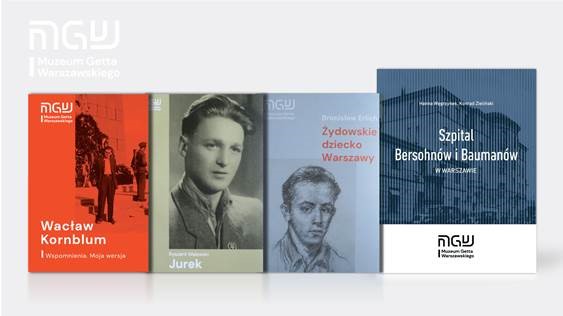
The Warsaw Ghetto Museum, as part of the Singer Festival and in cooperation with the National Film Archive – Audiovisual Institute, invites you on Friday, August 27th at 6:00 PM to a meeting entitled "The Warsaw Ghetto: Places and People," devoted to the memoirs of Holocaust Survivors published by the Museum.
The first publication to be presented will be the history of the Bersohn and Bauman Hospital, edited by Dr. Hanna Węgrzynek and Prof. Konrad Zieliński. "Bersohn and Bauman Hospital in Warsaw" presents the history of this important place in the history of Warsaw Jews and the Warsaw Ghetto. Located between Śliska and Sienna Streets, the children's hospital was established between 1876 and 1878 thanks to two families of Jewish industrialists and philanthropists who had made distinguished contributions to Warsaw. In November 1940, the building became part of the so-called Small Ghetto and operated until the Great Deportation Action in 1942. During the Warsaw Uprising, it served as a field hospital for the Home Army Group Chrobry II. Many renowned physicians worked at the hospital, including Henryk Goldszmidt ("Janusz Korczak"), who worked there from 1905 to 1912. During World War II, Marek Edelman was also associated with the hospital, working there as a messenger. After the war, the building continued to serve as a hospital, and until recently, it housed a children's infectious diseases ward. The Warsaw Ghetto Museum is currently being built in this historic building.
The main strand of publications published by the Warsaw Ghetto Museum is the memoirs of Holocaust Survivors. "Wacław Kornblum. Memoirs. My Version" opens a series of personal retrospections. The protagonist (born 1926) grew up in Warsaw in the 30s. At the time, he lived at 42 Śliska Street, near the Bersohn and Bauman Hospital. He attended a Bund-sponsored kindergarten, then a Bund school at 36 Krochmalna Street. Just before the outbreak of the war, the entire family moved to 35 Niska Street. Izaak Kornblum was thirteen years old at the time. His memoirs are an emotional story about the diversity of Jewish life in prewar Warsaw, Polish-Jewish relations during the occupation, a story of hiding and survival, and, finally, the postwar history of the Survivors. Today, Wacław Kornblum is a member of the Warsaw Ghetto Museum Council.
Ryszard Walewski's memoir, "Jurek," is dedicated to his best friend, Jurek Płoński, and other Ghetto Uprising participants. It is a subjective account of the German occupation, the Ghetto Uprising, the hardships of hiding on the so-called Aryan side, the daily struggle for survival, and the postwar fate of "Jurek"—Dawid. It is also a two-part narrative, in which Płoński's account is interwoven with the recollections of Ryszard Walewski, a participant in two uprisings—the Warsaw Ghetto Uprising and the Warsaw Uprising. The first edition of this book was published in Hebrew in 1976.
The museum's latest publication is "The Jewish Child of Warsaw" by Bronisław Erlich. The author's odyssey leads from the backstreets of pre-war Nalewki Street, from the devastated, occupied Warsaw, through the Eastern Borderlands, Germany, post-war Poland, and Israel, finally ending in Switzerland. This extraordinary story of survival, thanks to willpower, resourcefulness, and the help of those he encountered, is written by a pre-war Varsovian and Polish patriot.
The meeting will take place on Friday, August 27, at 6:00 PM in the "Ziemia obiecana" (Promised Land) Room at the National Film Archive – Audiovisual Institute, Wałbrzyska Street 3/5. Admission is free.
Safety rules
We make every effort to ensure your safety during FINA events, so please adhere to the following rules:
– read the Regulations for participation in FINA events open to the public at www.fina.gov
– remember to print and complete the mandatory health declaration available at www.fina.gov; the declaration will also be available at the FINA headquarters
– remember to cover your mouth and nose when you are on the FINA premises
– the cloakroom is closed until further notice – keep your distance from other guests
– take the seat designated by the FINA staff
– it is forbidden to bring food and drinks into the audiovisual room
– if you have symptoms of infection, stay at home.
If you have any questions or concerns, please contact the reception at bog@fina.gov.pl or by phone: 22 380 49 95 (Tue to Fri, 9am–17pm).