

Margalit (Emilia) Landau (1925–1943)
Activist of Ha-Shomer ha-Cair, fighter of the Warsaw Ghetto.
“Beautiful Emilia was the first among the crowd led to Umschlagplatz to throw a grenade at the guards leading the Jews there. She was killed on the spot (…)”.
Margalit, born in 1925 as the daughter of Aleksander Landau and Estera Rivka, was only 14 years old when Warsaw was conquered by the Nazis. As a teenager, she became involved in the activities of Ha-Shomer Ha-Cair, writing articles in the underground press published in the ghetto, sharing her thoughts. She stood out as a talented speaker.
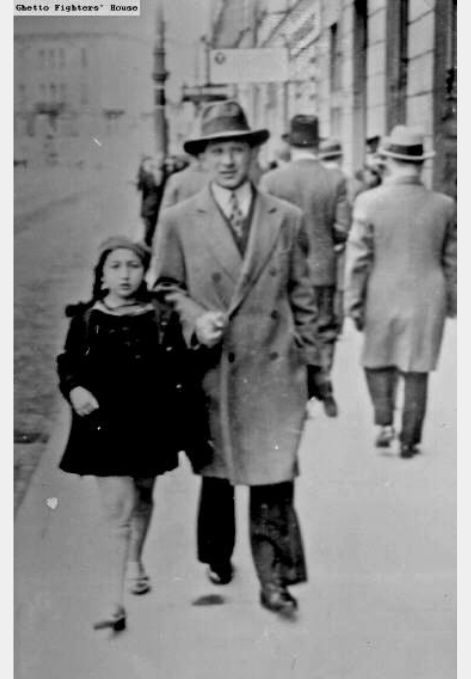
In April 1941, when the situation in the Warsaw ghetto was becoming increasingly difficult, 16-year-old Margalit tried to find ways to lift the spirits of her comrades in the movement. At that time, she wrote in the underground newspaper Ha-Shomer El-Al:
“You say ‘I hate’ (rightly so), you clench your fists (oh, that’s good), but that’s not enough. Find the smoldering sparks in the deaf emptiness of your enslaved soul and use them to set fire to the yoke of slavery.”
Two months later, on June 2, 1941, Landau published another text entitled “Forward!”:
“We are moving forward, along a path of thorns and hardship, toward the future. One may ask: how is it possible that we are moving forward today? But we must prove that it is possible.”
She described the tragic reality of life in the ghetto in harsh words: death lurking at every turn, constant hunger, despair, isolation, and lack of solidarity. She then appealed to young people:
“Jewish youth bow their heads in this historic hour and despair. Instead of encouraging their parents, they sink into indifference. (…) They have lost their sense of national pride. They are drowning in a swamp of moral and spiritual misery. They are afraid to look into the eyes of the future (…). They only see today. And we, the youth, must build our own tomorrow (…) Enough of these empty phrases. Heads up. We will persevere because we must persevere. Let hope enter our hearts. Let us look the future straight in the eye, without cowardice. We will not give in to doubt and despair. Forward – engraved on our banner. Forward – we are marching towards rebuilding a better and brighter tomorrow.”
Landau did not stop at words. Shortly after the Germans began the great liquidation of the ghetto on July 22, 1942, she joined the Jewish Combat Organization, which had been formed at that time. On August 17, she was captured by the Germans along with her comrades from the ŻOB – Eliahu Różański and Mordechaj Growas. Driven to the Umschlagplatz and put on a train bound for Treblinka, they managed to escape and return to Warsaw.
Margalit’s father, Aleksander, was an entrepreneur and ran a carpentry workshop at 30 Gęsia Street in Warsaw. In 1942, the workshop was taken over by the German company OBW (Ostdeutsche Bautischlerei), but Aleksander retained his managerial position. Margalit had a significant influence on her father; it was thanks to her that he became involved in underground activities. In August, during the liquidation campaign, she asked him to provide fictitious employment at the workshop for a large group of colleagues from the Ha-Shomer movement. Having a job in the workshops gave them a chance to protect themselves from deportation to Treblinka. The Shomrim (members of Ha-Shomer) were quartered in apartments belonging to the OBW at 48 and 61 Miła Street. Many members of Oneg Shabbat group also found shelter and employment in Landau’s workshop, and the apartment building at 61 Miła Street became an important meeting place for the ŻOB.
“Almost all of the Shomrim who are still alive are gathered on Miła Street,” wrote Aliza Witis-Szomron in her memoirs. “Hundreds of Shomrim gathered in three neglected apartments, where they lived as if in a commune. The underground’s activities were also concentrated there. (…) They had all lost their families, and the headquarters became their home.”
At the end of September 1942, after the liquidation operation was completed and over 250,000 Jews were transported to the Treblinka extermination camp, about 50,000 people remained in the ghetto. The Jewish Combat Organization then began to build underground structures and plan armed resistance. Death sentences were handed down to traitors. The first successful assassination by the Jewish Combat Organization was the execution of Jakub Lejkin, the deputy head of the Jewish Order Service, who was hated in the ghetto. Margalit and Israel Gutman tracked his route home from the police station; he was shot by Eliahu Różański.
Emanuel Ringelblum noted some time later:
“Lejkin, who had been turned by power and who had gone beyond all bounds in his loyalty to the Germans, was eliminated by the ŻOB, to the great admiration of the Jewish population.”
On January 18, 1943, the Germans began an operation to deport about 8,000 Jews to Treblinka, as they estimated that this was the number of people in the ghetto without legal employment. From early morning, they encountered passive resistance – most Jews ignored orders to report for document checks, instead hiding in prepared or improvised hiding places. The Germans were forced to search the buildings room by room and tried to capture the few people who had not managed to hide. Mordechaj Anielewicz, commander of the Jewish Combat Organization (ŻOB), decided to take up arms against the Germans. He assigned several people living together at 61 Miła Street to the operation; one of them was Margalit Landau.
The fighters, armed with weapons, mingled with the crowd of people being led to Umschlagplatz. At Anielewicz’s signal, at the corner of Zamenhofa and Niska Streets, they attacked the German officers. The Germans were taken by surprise and temporarily lost control of the situation; some of them fled, leaving their weapons behind. Thanks to this, several dozen Jews being led to Umschlagplatz managed to escape. Soon, however, the remaining German officers regained control. Facing a well-armed enemy, the Jewish fighters had no chance – almost all of them were killed. Eliahu (Alik) Różański wounded a German soldier and was himself fatally shot. Margalit – Emilka Landau – also died. She was the first woman to attack a German soldier in the ghetto, throwing a grenade at the guards leading Jews to Umschlagplatz. Her friend from the Jewish Combat Organization (ŻOB), Aliza Witis-Szomron, recalled years later:
“Beautiful Emilka was the first in the crowd being led to Umschlagplatz to throw a grenade at the guards leading the Jews there. She was killed on the spot (…). Emilka and Alik were a couple in love: they remained inseparable in life and in death. They were both 18 or 19 years old; they were the first to fall on the battlefield. We all mourned their deaths.”
Between January 18 and 22, 1943, members of the Jewish Combat Organization fought in several more clashes, wounding and killing at least a dozen Germans. After four days, the Germans withdrew from the ghetto; the interruption of the operation was widely attributed to the resistance of Jewish fighters. The Jews crossed the threshold of fear and ceased to see themselves solely as powerless victims. For the Jewish Combat Organization, this was a turning point – it boosted the organization’s morale and brought it recognition among the ghetto community. Perhaps without the January uprising, the Warsaw Ghetto Uprising would not have taken place a few months later, on April 19.
Historian Israel Gutman, who was a member of Ha-Shomer in the ghetto, recalled Margalit Landau and her participation in the “January self-defense” in a conversation with Professor Engelking:
“Two of my very close friends died there: Eliahu Różański and Margalit Landau, with whom I had been very close for some time. She took part in the assassination of Lejkin. She died in January. She was something… I have never encountered such fire in my life…”
Bibliography:
Archiwum Ringelbluma, t. 18: Prasa getta warszawskiego: Haszomer Hacair, Warszawa 2023.
Archiwum Ringelbluma. Dzień po dniu Zagłady, ed: M. Markowska, Warszawa 2008.
Berliński H., Zichronot, Moreshet Yalkut, 1963.
Emanuel Ringelblum. Kronika getta warszawskiego, wrzesień 1939-styczeń 1943, ed. A. Eisenbach, Warszawa 1983.
Engelking B., Leociak J., Getto warszawskie. Przewodnik po nieistniejącym mieście, Warszawa 2013.
Engelking B., Z profesorem Israelem Gutmanem rozmawia Barbara Engelking [in:] Zagłada Żydów. Studia i Materiały, no 9, 2013.
Grupińska A., Ciągle po kole. Rozmowy z żołnierzami getta warszawskiego, Wołowiec 2013.
Gutman I., Yehudei Warsha 1939-1943, Jerusalem 2011.
Mark B., Powstanie w getcie warszawskim, Warszawa 1963.
Witis-Szomron A., Młodość w Płomieniach, Warszawa 2013.