
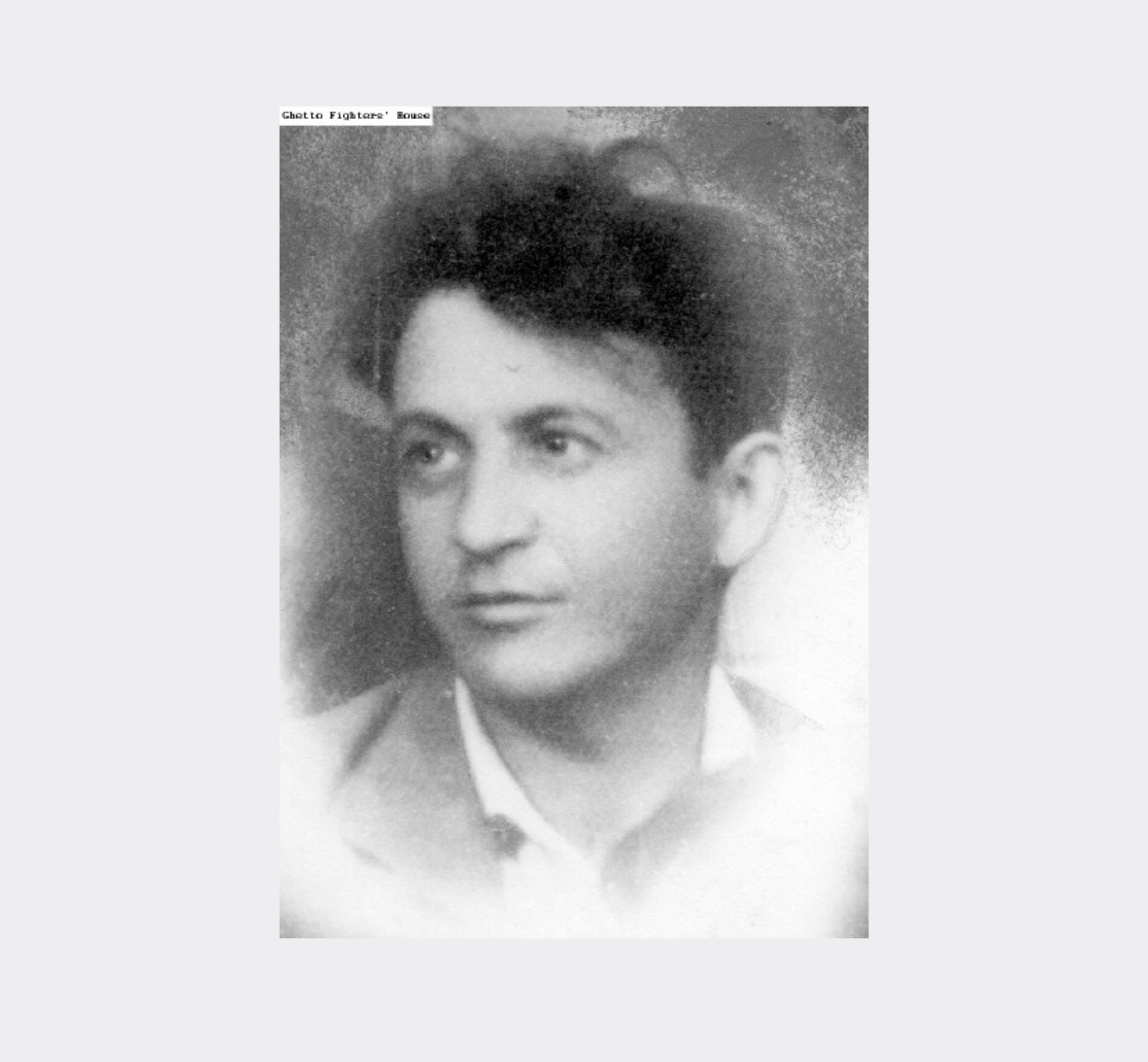
Fajnkind Melech (1898–1943)
Resistance fighter in the Warsaw Ghetto, commander of the Jewish Combat Organization (ŻOB) camp unit in Poniatowa.
“We are sounding the alarm (…) you must support us with weapons. (…) We urge you to help us. Help us die with dignity! We want to continue to follow in the footsteps of the heroes of the Warsaw Ghetto. We are ready,” wrote Melech Fajnkind in 1943, as commander of the ŻOB unit in the camp in Poniatowa.
He was born in 1898 in Warsaw and, as a teenager and an ideological socialist, he became politically involved, acting in the ranks of the Social Democracy of the Kingdom of Poland and Lithuania. At the age of 18, he joined the Poale Zion-Left party, representing the extreme left wing of Zionism.
In 1925, he left for Palestine, where for six years he co-founded the Poale Zion committee in Petach Tikva near Tel Aviv. In 1931, he returned to Poland for health reasons and continued his political activity in Warsaw, becoming one of the party’s leading activists.
After the outbreak of World War II, he found himself in the Warsaw ghetto and lived at 42 Dzielna Street. He worked for the Jewish Social Self-Help Organization in the Coordination Committee at 3/5 Tłomackie Street. Icchak Cukierman recalled in his book Nadmiar pamięci (A Surplus of Memory) that he knew Fajnkind as a person closely associated with the He-Chaluc Dror movement and a close friend of Dror activists:
“Thanks to him, we got paper for our newspapers, and he also helped us with printing and duplicating (…) He was a very handsome man.”
From 1940, Fajnkind was one of the regular collaborators of Oneg Shabbat group, working on a project to document life in the Warsaw Ghetto. In March 1942, he was one of the founders of the Anti-Fascist Block, an underground resistance organization bringing together Zionist and communist circles. After the great deportation of 1942, he participated in the founding meeting of the Jewish National Committee (ZKN), which brought together representatives of various political groups and exercised political supervision over the Jewish Combat Organization (ŻOB). Fajnkind joined the ZKN as a representative of the Supreme Council of Poale Zion-Left. He also sat on the Coordinating Committee of the ZKN and the Bund, and was a member of the ZKN’s propaganda committee, working alongside Cukierman and Abrasza Blum.
When the Warsaw Ghetto Uprising broke out on April 19, 1943, Fajnkind took part in it, but was soon captured and deported (along with thousands of Jews from Warsaw) to the Nazi labor camp in Poniatowa. Many of the prisoners in this camp had previously been members of the Jewish underground, which meant that the idea of resistance was alive among them. Fajnkind managed to organize a local branch of the Jewish Combat Organization (ŻOB) in the camp and became its commander.
The prisoners created an underground organization, producing Molotov cocktails and homemade daggers at night, preparing a plan for an armed uprising against the Germans.
A letter signed with the pseudonym “Malachowski” i.e., Fajnkind, addressed to the ŻOB headquarters and sent on September 15, 1943, has been preserved. In it, he asked for weapons and a unit of fighters to be sent to the camp to support the armed resistance from outside:
“We report: our organization here is sufficiently numerous and prepared. The human material is relatively good, but we are in constant need of help when it comes to weapons. We have absolutely no weapons.
And further, as above: ”We are sounding the alarm (…) you must support us with weapons. (…) We urge you. Help us die with dignity! We want to continue to follow in the footsteps of the heroes of the Warsaw Ghetto. We are ready.”
The plans prepared by the ŻOB were thwarted when, on the night of November 3-4, 1943, SS men and policemen from Lublin and the surrounding area, armed with machine guns, entered the camp and surrounded the area with a double cordon. They began murdering Jews, leading groups of 50 people to the place of execution. One of the last groups of prisoners (according to historian Bernard Marek, they were members of the Jewish Combat Organization) barricaded themselves in one of the barracks, putting up active resistance and opening fire. The Jews also managed to set fire to the SS clothing warehouses, destroying a significant amount of German uniforms. In response, the Germans set fire to the barracks where several hundred fighters were located. The Jews in the barracks were burned alive.
Melech Fajnkind was murdered on November 4, 1943, during Operation “Erntefest” (Harvest Festival), in which approximately 42,000 Jews were murdered in two days in the camps in Poniatowa, Trawniki, and Majdanek.
Bibliography:
Ringelblum Archive, vol. 11: Ludzie i Prace „Oneg Szabat”, Warsaw 2013.
Berman A., Wos der gojrl hot mir baszert. Kibbutz Lochame ha-Geta’ot, 1980.
Libionka D., Pierwszy zarys historii Żydowskiej Organizacji Bojowej [in:] Zagłada Żydów. Studia i Materiały, no 9, 2013.
Lenarczyk W, Libionka D., Erntfest (ed.) Zapomniany epizod Zagłady, Lublin 2009.
Mark B., Walka i zagłada warszawskiego getta, Warszawa 1959.
Zuckerman Y., A Surplus of Memory. Chronicle of the Warsaw Ghetto Uprising, Berkeley 1993