

Dora Fakiel (1914 – 1943)
Actress, dancer, singer
Taibele is a beautiful young woman who has been forced to marry an older man. However, she loves another man and decides to run away from the wedding. She is helped by Yiddle, a member of a traveling klezmer troupe, thanks to whom the would-be bride has the opportunity to fulfill her dream of performing as a singer. Together with the troupe, she sets off for Warsaw, where she gets a job at a theater and meets her beloved.
This is one of the plotlines of the 1936 film “Jidl mitn Fidl” (Yiddle With His Fiddle), which is considered one of the most outstanding achievements of Yiddish cinema and retains
its charm to this day, offering a glimpse into life in a pre-war Jewish shtetl. Many of the people we see in the film were, in fact, residents of town Kazimierz Dolny at the time.
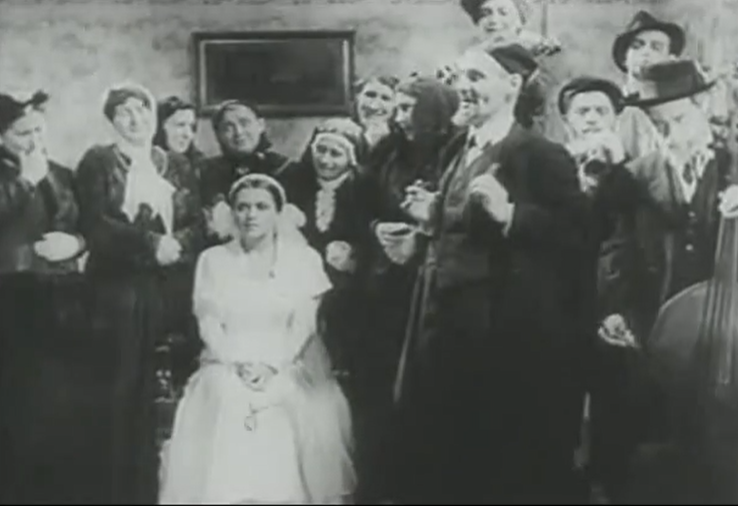
Dora Fakiel played her first and most recognizable role in this musical comedy directed
by Joseph Green and Jan Nowina Przybylski, portraying the character of Taibele.
By the age of twenty, she had already established herself in the Yiddish theater and film community in Poland. She was born in Warsaw in 1914, but unfortunately, we have
no further information about her family.
Following the success of “Jidl mitn Fidl,” the highest-grossing commercial Yiddish-language sound film of its era, she starred in the drama “On a heym” (1939), directed by Aleksander Marten. This production was based on a play by Jacob Gordin, also known in Poland under the title “Bezdomni” (The Homeless). The actress appeared in it alongside well-known Jewish stage actresses—Ida Kamińska and Wiera Gran. It was the last Yiddish feature film made in Poland before the outbreak of World War II and, at the same time, the last one featuring Fakiel.
Before the war broke out, Dora also performed on stage at the avant-garde Jewish Youth Theater (Jung Teater), founded in Warsaw and directed by Michał Weichert.
Her burgeoning artistic career was cut short by the outbreak of war. In 1940, she found herself in the Warsaw Ghetto. In the ghetto, she became involved with the Eldorado Theater, located on Dzielna Street. It was the first theater to open in the Warsaw Ghetto—
it began operations as early as December 1940. Its stage primarily featured light entertainment in Yiddish: comedies, revues, and folk operettas. The artistic quality of these performances was sometimes criticized by certain social activists. For the ghetto’s residents, however, it was an important space for temporary respite and relief, providing entertainment and emotional comfort amid extremely difficult living conditions.
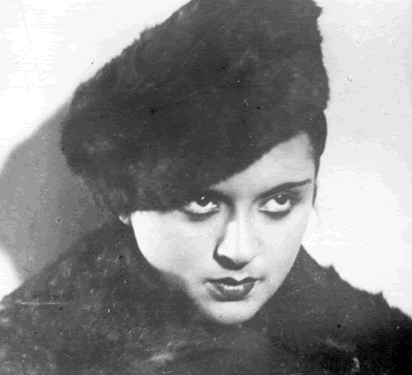
Fakiel performed on the Eldorado stage in several productions, as well as during dance benefit performances and special events.
A reviewer for “Gazeta Żydowska” newpaper, discussing the premiere of the play “Farkojfte Neszumes” (Sold Souls) in September 1941, wrote about the role Dora played in the production:
“Ms. Dora Fakiel, whom we had previously known only from her stage performances, presented herself beautifully both vocally and physically.”
In May 1942, she appeared in the play “Dus Kabaret Majdł” (The Cabaret Girl), staged as part of a benefit performance for the actress Regina Cukier. A reviewer for “Gazeta Żydowska” praised her role:
“A special highlight of the benefit was the third act, in which Ms. Dora Fakiel appeared as a gypsy, singing beautifully and charmingly.”
The artist also performed at the Melody Palace Theater, located at 12 Rymarska Street, where entertainment shows in Yiddish were also presented.
Henryk Makower wrote in his postwar memoirs:
“A grand cabaret—a dance hall on a European scale. A spacious, long, yet rather gloomy venue. (…) The programs featured the most outstanding artists from the ghetto; among my acquaintances, for example, Dora Fakiel.”
Makower, a doctor by profession, met Dora through his work and remembered her fondly: “my dear patient Dora Fakiel, a very talented actress with a warm and lovely voice.”
At the end of June 1942, the premiere took place of “Der Dorf-Jung” (The Young Villager)—an exceptionally ambitious play by Eldorado Theater standards—in which Dora played the role of Natasha. It was the last performance in which she appeared.
On July 22, 1942, the Germans launched the The Grossaktion Warsaw (“Great Action“) – deportation and mass murder of Jews from the Warsaw Ghetto. As a result, approximately 265,000 Jews were deported from Warsaw to the Treblinka extermination camp, including many artists and cultural figures. Fakiel managed to survive this wave of deportations and found employment in Karl Heinz Müller’s shed on Grzybowski Square. During the period when the so-called “remnant ghetto” existed, she also worked in Többens’s shed.
After the outbreak of the Warsaw Ghetto Uprising in April 1943, she was captured and deported, along with several thousand other Warsaw Jews, to the German labor camp
in Poniatowa.
She died on November 4, 1943, during Operation “Erntefest” (Harvest Festival), in which the Germans murdered approximately 42,000 Jews over the course of two days in the Lublin region—in the camps at Poniatowa, Trawniki, and Majdanek.
Bibliography:
Makower H., Pamiętnik z getta warszawskiego, Wrocław 1987.
Emanuel Ringelblum. Kronika getta warszawskiego, wrzesień 1939-styczeń 1943, red. A. Eisenbach, Warszawa 1983.
Gross N., Film żydowski w Polsce, Kraków 2002. Turkow J., C´était ainsi 1939-1943, Paryż 1995.
Kuligowska-Korzeniewska A, Leyko M., Teatr Żydowski w Polsce, Łódź 1998.
Gazeta Żydowska nr. 19, 7 March 1941.
Gazeta Żydowska nr. 48, 17 June 1941.
Gazeta Żydowska nr. 81, 5 September 1941.
Gazeta Żydowska nr. 102, 24 October 1941.
Gazeta Żydowska nr. 13, 30 January 1942.
Gazeta Żydowska nr. 61, 24 May 1942.
Gazeta Żydowska nr. 73, 21 June 1942.